
(Women Participation in Labour Force)
One simple question – are women really not working, or are we just not counting their work????
If we look closely, we will see that women are always busy. From morning to night, they are doing something -cooking, cleaning, managing the house, taking care of children and elders. Still, many of them are called “non-working”. On the other hand, a woman who earns money outside is called “working”.
This difference is the real issue.
Women participation in the labour force means how many women are working or trying to get work. It shows how much women are part of the country’s economy. When women work, they earn money, become independent, and help their families live a better life. It also increases confidence and gives them a voice in decision-making at home and in society.
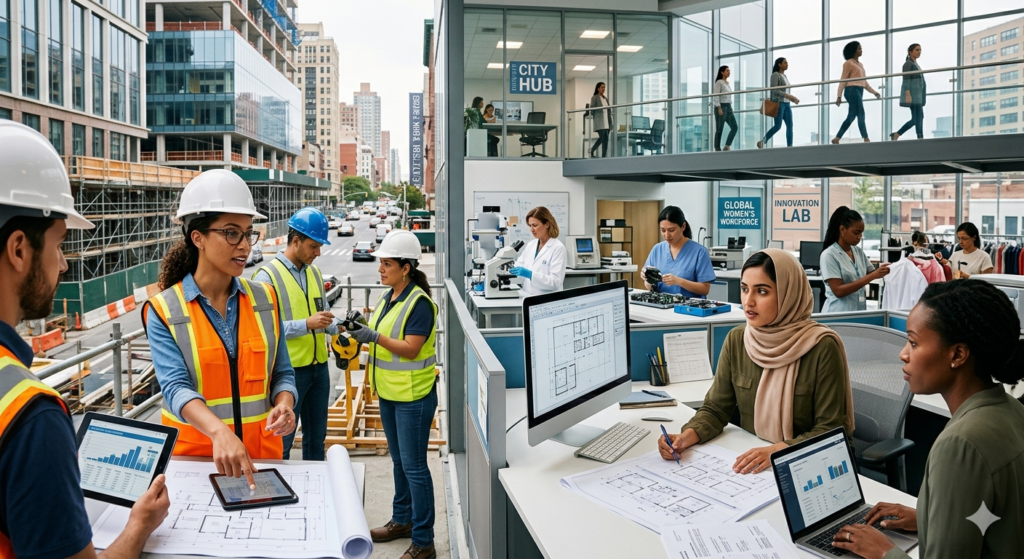
In the last few years, there has been some improvement. Today, around 35 out of 100 women are part of the labour force (2025–26). Earlier, this number was much lower, around 20–25 out of 100. This shows that more women are now coming forward to work and take part in economic activities.
In villages, the number is even higher, close to 40 out of 100 women, because many women work in farming, animal care, and small household industries. But in cities, the number is still lower because of lifestyle, safety concerns, and fewer flexible job options.
Even after this progress, the gap between men and women is still very large. Most men are working, but many women are still left out. This clearly shows that the problem is not ability, but opportunity.
Now the important question is – what is stopping women????
Main Reasons
1. Thinking of Society:-
In many families, people still believe that a woman’s main role is at home. This thinking starts from childhood.
For example, boys are often encouraged to dream big and build careers, while girls are told to learn household work. If a girl wants to go to another city for a job, she may not be allowed. After marriage, many women leave their jobs because they are expected to take care of the family. This mindset becomes a big barrier in their growth.
2. Lack of Education:-
Education is the base of every opportunity. Without education, it becomes very difficult to get a good job.
In many areas, girls are still not given equal importance in education. Some girls leave school early due to financial problems, early marriage, or family pressure. Because of this, they miss the chance to build a career. An educated woman not only works but also supports her children’s future in a better way.
3. Safety Problems:-
Safety is one of the biggest concerns for women. Many women do not feel safe while travelling or working, especially at night or in isolated areas.
For example, a woman may reject a good job offer because it requires late working hours or long travel. Families also feel worried about safety, so they restrict women from going out. This reduces their chances of getting better jobs.
4. Unpaid Work (Hidden Work):-
This is the most ignored but important issue.
Women spend many hours doing household work like cooking, cleaning, washing, and taking care of children and elders. This work is not counted in the economy, but it is very important for daily life.
For example, if a woman spends 6–7 hours daily on housework, she may not have enough time or energy left to do a paid job. In reality, she is working, but her work is not recognised.
5. Problems at Workplace:-
Even when women get jobs, they face many challenges.
Women are sometimes paid less than men for the same work
Promotions are not given equally
Lack of childcare facilities
No flexible working hours
Because of these problems, many women leave their jobs after marriage or childbirth. This reduces long-term participation.
6. Low Income and Informal Jobs:-
Many women work in jobs that are not stable or secure.
For example, working in farms, doing daily wage labour, or small home-based work like stitching or packaging. These jobs do not provide fixed income or job security. So even if women are working, their financial condition may not improve much.
Positive Changes (Things Are Improving):-
Even with all these challenges, positive changes are clearly visible.
More girls are going to school and college
Women are entering different professions
Awareness about women’s rights is increasing
Today, women are working as teachers, doctors, engineers, police officers, and even running businesses.
For example, in villages, women are forming groups and starting small businesses like making pickles, papad, handicrafts, or dairy products. These small steps are helping them earn money and become confident.
In cities, many women are using mobile phones and the internet to work from home. They are selling products online, teaching students, or doing freelance work. This is creating new opportunities.
Technology has made a big difference. It has reduced the need to go outside for work. Now women can manage both home and work more easily.
In some work areas, around 40–45 women out of 100 workers are women, which clearly shows that women are ready to work if they get the right opportunity and support.
What Can Be Done?????
To increase women participation, some simple but strong steps are needed:-
Change in mindset – Families should support girls and treat them equally
Better safety – Safe transport and workplaces should be ensured
Equal pay – Women should get equal salary for equal work
Work support – Childcare facilities and flexible working hours
Support from men – Sharing household responsibilities
For example, if men help in daily housework, women will get more time and energy to focus on their careers.
Skill development is also very important. Women should learn skills like computer knowledge, communication, and technical work. This will help them move into better and higher-paying jobs.
Conclusion:-
Women are already working every day, but not all their work is seen or counted.
If women get equal opportunities, they can achieve great success. They can improve their family’s life and also contribute to the country’s growth.
The situation is improving, but still not enough. Real change will come only when society supports women, gives them safety, respect, and equal chances.
A country becomes truly strong when both men and women grow together.
So, increasing women participation in the labour force is not just important – it is necessary for a fair and better future.