
Introduction:-
For any country, the government plays a major role in economic development. It spends money on infrastructure, defence, education, healthcare, social welfare and many other sectors. These expenditures are necessary for improving living standards and promoting economic growth.
At the same time, the government earns revenue mainly through taxes and other sources such as fees, dividends and disinvestment. However, in many cases government expenditure becomes higher than its income. This situation creates a gap in public finances.
This gap is known as fiscal deficit, and to fill this gap the government borrows money. Continuous borrowing over many years leads to the accumulation of public debt.
For a developing economy like India, fiscal deficit and public debt are very important indicators. They show the financial condition of the government and help economists understand whether government finances are sustainable or under pressure.
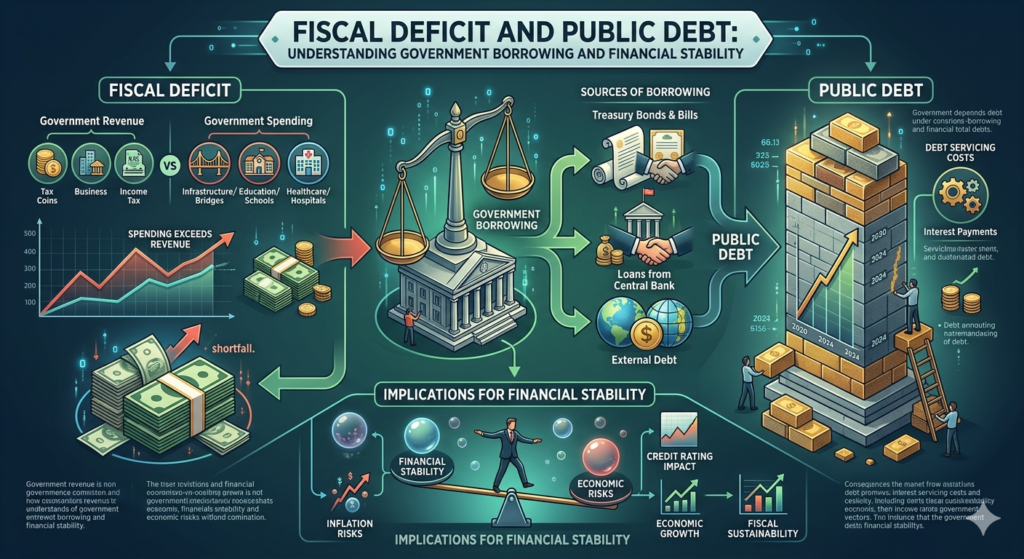
Meaning of Fiscal Deficit:-
Fiscal deficit refers to the difference between the government’s total expenditure and its total revenue excluding borrowings during a financial year.
In simple terms, it shows how much money the government needs to borrow to meet its expenses.
(Simple Formula)
Fiscal Deficit = Total Expenditure − Total Revenue (excluding borrowings)
A higher fiscal deficit means the government is borrowing more to finance its activities.
(Fiscal Deficit in the Current Period)
According to recent budget estimates:-
Fiscal deficit is estimated at around 5.1% of GDP in 2024–25
The government aims to reduce it to around 4.5% of GDP by 2025–26
This gradual reduction is part of a strategy to maintain economic stability while continuing development spending.
Main Components of Fiscal Deficit:-
Fiscal deficit arises due to the combined effect of high expenditure and limited revenue. Some important components include the following.
1. Government Development Expenditure:-
Governments invest heavily in development activities such as:-
Building roads, highways and railways
Expanding digital infrastructure
Urban development projects
Energy and transport systems
These investments support long-term economic growth but also increase government spending.
2. Welfare and Social Programmes:-
Large public funds are spent on social welfare schemes including:-
Food support programmes
Rural employment schemes
Healthcare initiatives
Education and skill development
These programmes are essential for inclusive growth but add to fiscal pressure.

3. Subsidies:-
Governments provide subsidies to support farmers and consumers. Major subsidies are generally given in areas such as:-
Food
Fertiliser
Energy
While subsidies help protect vulnerable groups, excessive subsidies can increase fiscal deficit.
4. Interest Payments on Existing Debt:-
A large part of government expenditure goes toward interest payments on previously borrowed money.
Currently, interest payments account for more than one-fourth of the central government’s revenue expenditure, making debt servicing a major fiscal responsibility.
Understanding Public Debt:-
Public debt refers to the total amount of money that the government owes due to past borrowing.
Whenever the government runs a fiscal deficit, it needs to borrow funds. Over time, these borrowings accumulate and form public debt.
Public debt is therefore the result of continuous fiscal deficits over many years.
Types of Public Debt:-
Public debt is usually classified into two main categories.
1. Internal Debt:-
Internal debt refers to borrowing within the country.
Major sources include:-
Government securities and bonds
Treasury bills
Borrowing from banks and financial institutions
Small savings schemes
Internal debt forms the largest share of India’s total government borrowing.
2. External Debt:-
External debt refers to borrowing from foreign lenders.
This includes loans from:-
Foreign governments
International financial institutions
Global financial markets
External borrowing must be managed carefully because exchange rate fluctuations can increase repayment burden.
Current Public Debt Situation:-
Public debt in India has increased over time due to development needs and economic challenges.
Some key indicators include:-
Combined public debt of the central and state governments is around 81–82% of GDP.
Central government debt alone is around 58–59% of GDP.
Interest payments form a large portion of government expenditure.
Although these numbers appear high, economists consider the debt manageable if economic growth remains strong and fiscal discipline is maintained.
Relationship Between Fiscal Deficit and Public Debt:-
Fiscal deficit and public debt are closely linked.
The relationship works in the following sequence:-
Government expenditure exceeds revenue.
Fiscal deficit occurs.
Government borrows money to finance the deficit.
Borrowing accumulates over time and becomes public debt.
Therefore, continuous fiscal deficits automatically increase public debt.
Reducing fiscal deficit over time helps in stabilizing debt levels.
Why Fiscal Deficit Can Be Beneficial???
Fiscal deficit is often seen as a negative indicator, but moderate deficit can support economic development.
1. Promoting Infrastructure Development:-
Government borrowing allows large investments in infrastructure such as highways, ports, railways and renewable energy. These investments improve productivity and attract private investment.
2. Supporting Economic Growth During Slowdowns:-
During economic downturns, governments increase spending to stimulate demand. Higher fiscal deficit during such periods can help revive economic activity.
3. Expanding Social Welfare:-
Developing countries require significant investments in healthcare, education, rural development and poverty reduction. Fiscal deficit helps finance these programmes.
Risks of High Fiscal Deficit:-
If fiscal deficit becomes too large, it can create several economic challenges.
Inflationary Pressure:-
High government spending financed through borrowing may increase money supply, which can lead to inflation.
Higher Interest Rates:-
When government borrowing increases significantly, interest rates may rise. This can reduce private investment because businesses face higher borrowing costs.
Increasing Debt Burden:-
Continuous borrowing leads to rising public debt. A large debt burden increases interest payments and reduces funds available for development.
Fiscal Vulnerability:-
Very high debt levels can weaken government finances and make the economy vulnerable during crises.
Steps to Control Fiscal Deficit:-
Governments adopt several measures to maintain fiscal discipline.
Strengthening Fiscal Responsibility:-
Fiscal policy frameworks aim to control deficits and maintain sustainable debt levels.
Improving Tax Collection:-
Expanding the tax base and improving compliance through digital systems increases government revenue.
Efficient Subsidy Management:-
Targeted subsidy delivery helps reduce wasteful expenditure and ensures benefits reach the intended groups.
Encouraging Economic Growth:-
Higher economic growth increases government revenue through higher tax collections, helping reduce fiscal deficit.
Public Debt Management Strategies:-
Managing public debt effectively is important for maintaining financial stability.
Important strategies include:-
Borrowing at lower interest rates
Increasing long-term borrowing to reduce repayment pressure
Maintaining a stable debt-to-GDP ratio
Reducing dependence on external borrowing
Effective debt management helps reduce financial risks and maintain investor confidence.
Fiscal Consolidation:- The Long-Term Strategy
Fiscal consolidation refers to the gradual reduction of fiscal deficit and stabilization of public debt.
The main goals include:-
Strengthening macroeconomic stability
Reducing interest burden
Maintaining sustainable government finances
Creating more fiscal space for development spending
Gradual consolidation is important because sudden cuts in government expenditure could slow economic growth.
Conclusion:-
Fiscal deficit and public debt are important indicators of a country’s financial health. Fiscal deficit shows the gap between government expenditure and revenue, while public debt represents the accumulated borrowing of the government.
For a developing country like India, moderate fiscal deficit can support infrastructure development, social welfare programmes and economic growth. However, excessive deficit can lead to inflation, rising interest rates and increasing debt burden.
Therefore, maintaining a balance between development spending and fiscal discipline is essential. With strong economic growth, efficient tax collection and responsible borrowing, the government can manage fiscal deficit effectively while ensuring long-term economic stability.
A sustainable fiscal policy will help create a strong foundation for future development and financial stability.