
Introduction:-
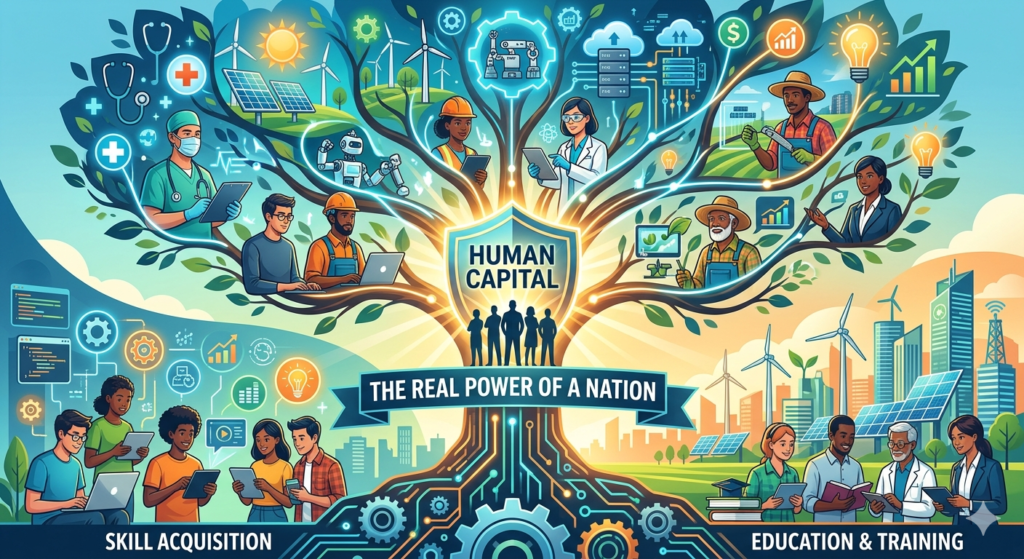
A country does not become powerful only because of its buildings, industries, or technology. Its real strength lies in its people. When people are educated, skilled, and healthy, they become the biggest asset of a nation. This is known as human capital.
In today’s time, just having a degree is not enough. What really matters is whether a person has the right skills to work, solve problems, and adapt to change. That is why skill development has become one of the most important priorities for any growing economy.
India has a huge youth population. This can be a blessing if they are skilled, but it can become a challenge if they remain untrained. So, the focus must be on turning this population into productive human capital.
Understanding Human Capital in Simple Words:-
Human capital simply means the value of people in terms of their skills, knowledge, and health.
For example:-
A skilled electrician can solve problems quickly
A trained nurse can save lives
A creative entrepreneur can generate jobs
So, when a country invests in education and skills, it is actually investing in its future growth.
Why Skill Development is So Important????
Skill development is not just about learning; it is about becoming capable.
1. Makes People Job-Ready:-
Many students complete their education but still struggle to find jobs. The main reason is lack of practical skills. Skill training fills this gap.
2. Improves Productivity:-
A skilled worker can do the same work in less time and with better quality. This helps industries grow faster.
3. Supports Economic Growth:-
When more people are working efficiently, the economy grows. Countries with skilled populations generally have stronger economies.
4. Builds Confidence:-
When a person has a skill, they feel more confident and independent. This also improves their quality of life.
Present Situation:- Opportunity and Challenge
India is one of the youngest countries in the world. A large part of its population is in the working-age group. This gives India a big advantage.
But there is a problem:-
Many graduates are not job-ready
Companies often say they cannot find skilled workers
A large number of people work in the informal sector without proper training
This shows a clear gap between education and employment.
A Real-Life Example:-
Imagine two student,
One student completes a degree but has no practical experience
Another student learns a skill like coding, tailoring, or digital marketing along with studies
Who will get a job faster????
Obviously, the second one.
This simple example shows why skills matter more than just degrees.
Steps Being Taken to Improve Skills:-
In recent years, many efforts have been made to improve skill development across the country.
Focus on Practical Training:-
Training programs now focus more on hands-on learning instead of only theory.
Digital Skills Are Growing:-
With the rise of technology, skills like computer knowledge, online work, and digital tools are becoming essential.
Industry-Based Learning:-
Efforts are being made to match training with real industry needs so that people can easily get jobs.
Rural Skill Development:-
Training is also reaching villages so that rural youth can get better opportunities without migrating.
Major Challenges Still Exist:-
Even after progress, some problems still need attention:
1. Quality Issue:-
Not all training centers provide proper education and facilities.
2. Lack of Awareness:-
Many people do not even know about available skill programs.
3. Old Mindset:-
Some people still believe only traditional degrees are valuable, which is not true in today’s world.
4. Fast Changing Technology:-
Skills become outdated quickly, so people need to keep learning new things.
Role of Education System:-
The education system must change according to modern needs.
What Should Be Done:-
Add skill-based subjects in schools
Encourage practical learning
Provide internships and real-life exposure
Focus on creativity and problem-solving
Education should not just prepare students for exams, but for real life.
Importance of Lifelong Learning:-
Learning should never stop.
In today’s world:-
New technologies keep coming
Job requirements keep changing
So, people must keep updating their skills. This is called lifelong learning.
For example:-
A worker learning new machines
A student learning new software
A businessperson learning online marketing
This habit keeps a person relevant and successful.
Skill Development in the Digital Era:-
Technology has opened many new opportunities.
Today, people can learn from anywhere using the internet.
High-Demand Skills:-
Artificial Intelligence
Data analysis
Cybersecurity
Digital marketing
Freelancing and remote work
These areas are expected to create a large number of jobs in the coming years.
Women and Skill Development:-
Women are an important part of human capital.
When women get proper skills:-
They become financially independent
They contribute to family income
They help in overall development of society
Special focus on women’s skill development can bring big positive change.
Boosting Rural Economy Through Skills:-
Rural areas have great potential.
Skill development can:-
Create local job opportunities
Promote small businesses
Reduce pressure on cities
Skills like food processing, handicrafts, and digital services can change rural economies.
The Way Forward:-
To fully develop human capital, a strong plan is needed.
Key Actions:-
Improve quality of training
Increase investment in education and health
Connect industries with training programs
Encourage skill certification
Promote startups and innovation
If these steps are followed, the country can fully use its human potential.
Conclusion:-
Skill development and human capital are the true engines of growth. A country cannot progress if its people are not skilled and capable.
India has a golden opportunity because of its young population. By focusing on skills, the country can create jobs, reduce poverty, and become stronger globally.
In simple words, buildings and machines do not create progress-people do.
And when people are skilled, the future becomes brighter.