
Role of Agriculture in the Indian Economy
Where India’s Growth Truly Begins????
Introduction:- India’s Economy Starts from the SoilBefore factories, offices, and highways, there are farms. Before economic numbers and reports, there are farmers. In India, agriculture is not just an occupation—it is the starting point of the economy. From food on our plates to jobs in markets, agriculture quietly supports everything.
Even today, when India is moving fast towards modernization, agriculture remains the base that keeps the economy balanced, stable, and alive.
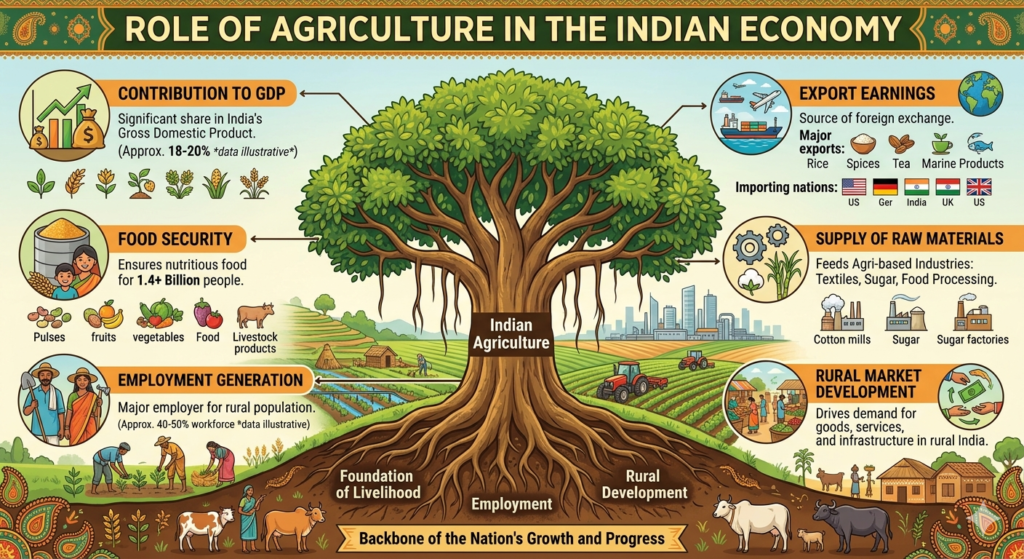
Agriculture:- (The Everyday Work of Millions)
In India, agriculture gives work to more people than any other sector. Millions of families depend on farming for their daily income.
This includes:-
Farmers working on their own land.
Farm workers helping during sowing and harvesting.
People working in dairy, poultry, and fisheries.
Workers involved in transport, storage, and selling of crops.
For many villages, farming is the main source of work. When agriculture earns, rural families survive. When agriculture suffers, rural life becomes difficult. That is why agriculture is closely connected to people’s lives.
The Heart of Rural India:-
Most Indian villages live around agriculture. The village economy moves when farming performs well.
When farmers earn money:-
They spend more in local shops.
Small village businesses grow.
Better homes, schools, and health services develop.
This helps villages become stronger and more self-reliant. A healthy agricultural sector reduces the need for people to move to cities in search of work.
Agriculture and National Income:-
Over time, industries and services have grown, but agriculture still plays an important role in India’s national income.
Agriculture supports many related activities such as:-
Milk production.
Fish farming
Poultry farming.
Forestry.
These activities together add value to the economy. Agriculture also increases demand for tools, seeds, fertilizers, and machines, which supports other sectors.
Food Security:- (Feeding a Large Nation)
India has a very large population, and feeding everyone every day is a big challenge. Agriculture makes this possible.
Indian farmers grow:-
Rice and wheat.
Pulses and grains.
Fruits and vegetables.
Milk and other food products.
Because of agriculture, India is able to produce most of its food within the country. This reduces dependence on imports and keeps food prices under control. Food security also means social stability.
Agriculture and Industries:- (A Strong Connection)
Many industries depend directly on agriculture for raw materials.
For example:-
Cotton supports textile factories.
Sugarcane supports sugar mills.
Oilseeds support oil industries.
Jute supports packaging units.
If agriculture slows down, these industries are affected. When agriculture grows, industries grow too. This close link makes agriculture a foundation for industrial development.
Agriculture in Global Trade:-
Agriculture also helps India earn money from other countries. Indian farm products are exported across the world.
Major exports include:-
Rice.
Spices.
Tea and coffee.
Fruits and vegetables.
These exports bring foreign income and improve India’s trade position. They also give Indian farmers access to global markets.
Agriculture and the Service Sector:-
Modern agriculture is no longer limited to farming alone. It is connected to many services.
These include:-
Food processing units.
Cold storage and warehouses.
Transport and marketing services.
Digital platforms for crop selling.
This connection creates new jobs and opportunities, especially for young people. Technology is slowly changing how farming is done and sold.
A Tool for Inclusive Growth:-
Agriculture supports inclusive growth, meaning growth that reaches everyone.
It supports small and marginal farmers.
It gives income to poor families.
It reduces the gap between rural and urban areas.
Because agriculture touches the lives of the poorest sections, its growth leads to more equal development.
Problems Faced by Indian Agriculture:-
Despite its importance, agriculture in India faces several problems.
Some major challenges are:-
Dependence on rainfall.
Small and divided land holdings.
Limited access to modern technology.
Unstable crop prices.
These problems affect farmers’ income and confidence. Solving them is necessary for the long-term health of the economy.
Modern Farming:- (A New Beginning)
Indian agriculture is slowly changing with time.
Better quality seeds are being used.
Irrigation methods are improving.
Organic and natural farming are growing.
Digital tools are helping farmers sell crops.
Modern farming can increase productivity and reduce risks. It can also make agriculture more profitable and sustainable.
Government Support for Agriculture:-
The government plays an important role in supporting farmers.
Some efforts include:-
Income support programs.
Crop insurance schemes.
Better market access.
Investment in storage and irrigation.
These steps aim to protect farmers from losses and strengthen the agricultural system.
Agriculture as a Safety Net.-
During economic problems, agriculture acts as a safety net.
Food production continues even during crises.
Rural income does not completely stop.
This makes agriculture a stabilizing force in the Indian economy.
Conclusion:- (Agriculture Is India’s Strongest Foundation)
Agriculture is the base on which India’s economy stands. It feeds the nation, gives work to millions, supports industries, and keeps rural India alive. Even in a fast-growing and digital India, agriculture will always remain important.
For a strong and balanced future, India must continue to value and support its farmers.
(“When the soil is strong, the nation is strong”.)