
Skill development in india
1. Introduction:- Skill as the Foundation of Development
India is often described as one of the youngest countries in the world. A large proportion of its population belongs to the working-age group. This demographic advantage can become a strong driver of economic growth if the workforce is productive and skilled. However, a young population alone cannot guarantee development. The real strength of a nation lies in the quality of its human capital, which depends largely on education and skills.
In the present era of globalisation, technological change and digital transformation are reshaping the nature of work. Industries now require workers who are not only educated but also possess technical knowledge, practical abilities and problem-solving skills. Therefore, skill development has become a central component of economic policy in India.
For a country where millions of youth enter the labour market every year, providing skill training is essential for improving employment opportunities, reducing poverty and strengthening economic growth. Thus, building a skilled workforce is not only an economic necessity but also a social priority.
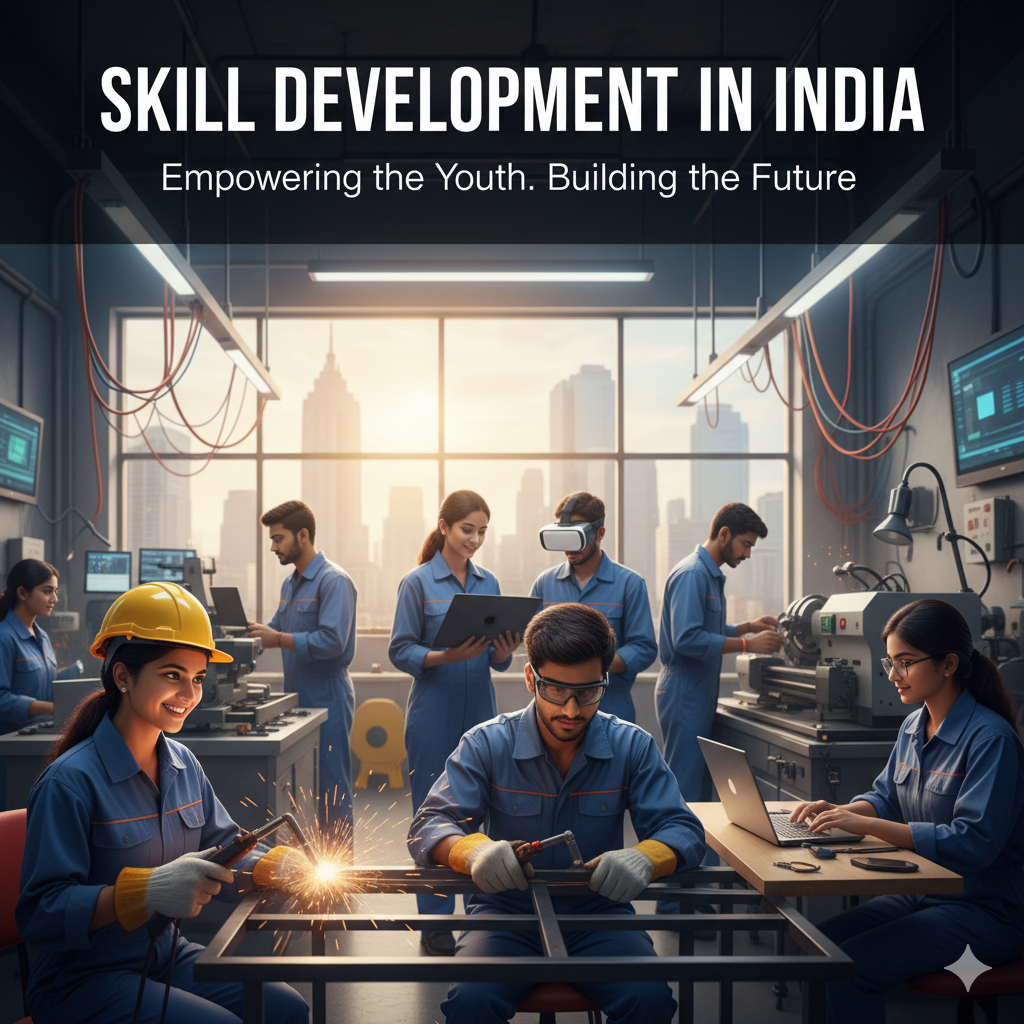
2. India’s Demographic Potential and Workforce Reality:-
India’s population structure provides a unique opportunity for economic expansion.
India has a workforce of more than 520 million people.
Nearly 12–15 million young individuals enter the labour market every year.
However, only about 4–5% of the workforce has received formal skill training.
This percentage is significantly lower compared to many developed countries where vocational training forms an essential part of the education system.
Another major characteristic of India’s labour market is the large informal sector, which employs a majority of workers. In this sector, skills are often learned through traditional methods and experience rather than through structured training programmes.
At the same time, emerging sectors such as information technology, electronics manufacturing, logistics, renewable energy, healthcare and digital services are expanding rapidly. These sectors require specialised skills, highlighting the urgent need for a strong skill development ecosystem.
3. Government Initiatives and Skill Development Schemes:-
Recognising the importance of skilled manpower, several national initiatives have been launched to expand training opportunities and improve employability.
1. Skill India Mission:-
Launched with the objective of creating a large skilled workforce, this mission aims to train millions of young people across different sectors of the economy.
2. Pradhan Mantri Kaushal Vikas Yojana (PMKVY):-
This programme focuses on providing short-term training and certification to youth in various sectors such as retail, electronics, construction, healthcare and hospitality. Certified candidates receive recognition that improves their chances of employment.
3. National Skill Development Corporation (NSDC):-
This institution works with private training partners and industries to expand skill training across multiple sectors.
4. Industrial Training Institutes (ITIs):-
ITIs provide vocational education in technical trades such as electrical work, mechanical operations, automobile repair and welding. These institutes play a vital role in producing skilled technicians.
5. National Apprenticeship Promotion Scheme (NAPS):-
This programme encourages industries to provide apprenticeship opportunities so that students can gain practical workplace experience.
6. Digital Skill Programmes:-
With the expansion of the digital economy, many initiatives now focus on computer literacy, data analysis, coding, and digital entrepreneurship.
Together, these initiatives aim to create a workforce that is capable of meeting the demands of modern industries.
4. Importance of Skill Development for India:-
Skill development plays a crucial role in promoting economic and social progress.
Boost to Economic Growth:-
A skilled workforce increases productivity and efficiency, which strengthens industrial output and national income.
Employment Generation:-
Training improves employability by equipping individuals with practical skills demanded by employers.
Strengthening Manufacturing Sector:-
India aims to expand its manufacturing capacity and become a major production hub. This requires technicians, engineers and trained workers.
Promotion of Entrepreneurship:-
Skill development also encourages self-employment. Individuals with vocational skills can establish small businesses and contribute to local economic activity.
Enhancing Global Competitiveness:-
Countries with skilled labour forces are better positioned to attract international investment and participate in global value chains.
5. Key Challenges in Skill Development;-
Despite progress in recent years, several challenges continue to affect the effectiveness of skill development programmes.
Quality of Training Infrastructure:-
Some training centres lack modern equipment and well-trained instructors, which reduces the effectiveness of training.
Mismatch Between Education and Industry Needs
Many graduates possess theoretical knowledge but lack practical skills required in the workplace.
Limited Awareness in Rural Areas:-
A significant number of young people in rural and remote areas are not aware of available skill training opportunities.
Social Preference for Academic Degrees:-
Vocational training is often considered less prestigious compared to traditional academic education.
Gender Gap in Skill Participation:-
Women’s participation in many training programmes remains limited due to social barriers and lack of support systems.
Regional Imbalance:-
Skill infrastructure is unevenly distributed across states, creating disparities in access to training.
6. Role of Technology in Transforming Skill Development:-
Technological advancement is playing an increasingly important role in improving skill training systems.
Digital learning platforms allow individuals to access educational resources from anywhere. Online courses, virtual classrooms and digital simulations help students develop practical skills more effectively.
Emerging technologies such as artificial intelligence, robotics, automation and data analytics are transforming industries. As a result, workers must continuously update their skills to remain relevant in the labour market.
Technology can therefore act as a powerful tool for expanding access to skill training and improving learning outcomes.
7. Role of States, Industry and Educational Institutions:-
Skill development requires cooperation among multiple stakeholders.
State Governments must strengthen training infrastructure and design programmes that match regional economic needs.
Industries should collaborate with training institutions to provide internships, apprenticeships and practical exposure.
Educational Institutions need to integrate vocational courses with traditional academic programmes so that students develop both theoretical knowledge and practical expertise.
Society and Families must also recognise the value of vocational education and encourage youth to pursue skill-based careers.
8. Way Forward:- Strengthening the Skill Ecosystem
To fully utilise its demographic advantage, India must adopt a comprehensive approach to skill development.
Important steps include:-
Modernising training institutes and infrastructure
Expanding industry partnerships and apprenticeship programmes
Increasing women’s participation in skill training
Strengthening training facilities in rural and semi-urban areas
Integrating digital technology into skill education
Promoting entrepreneurship and start-up culture
Aligning training programmes with industry requirements
A coordinated effort in these areas can help create a workforce that is skilled, productive and capable of meeting future economic challenges.
9. Conclusion:-
Skill development is one of the most important factors determining India’s future economic trajectory. A young population can become a powerful asset only when it is supported by proper training, education and employment opportunities.
By improving the quality of training institutions, expanding vocational education and strengthening partnerships between industry and education, India can transform its demographic advantage into sustainable economic growth.
In the coming decades, countries with skilled and adaptable workers will lead the global economy. If India continues to invest in skill development and ensures equal opportunities for all sections of society, it can emerge as a strong and competitive nation on the global