
Farming is changing faster than before. Earlier, when we talked about farm machines, we mostly thought about tractors, harvesters and irrigation pumps. Today, the picture is different. Drones, smart sensors, automatic machines, artificial intelligence and agricultural robots are slowly entering farms.
But there is one question that matters more than the technology itself:-
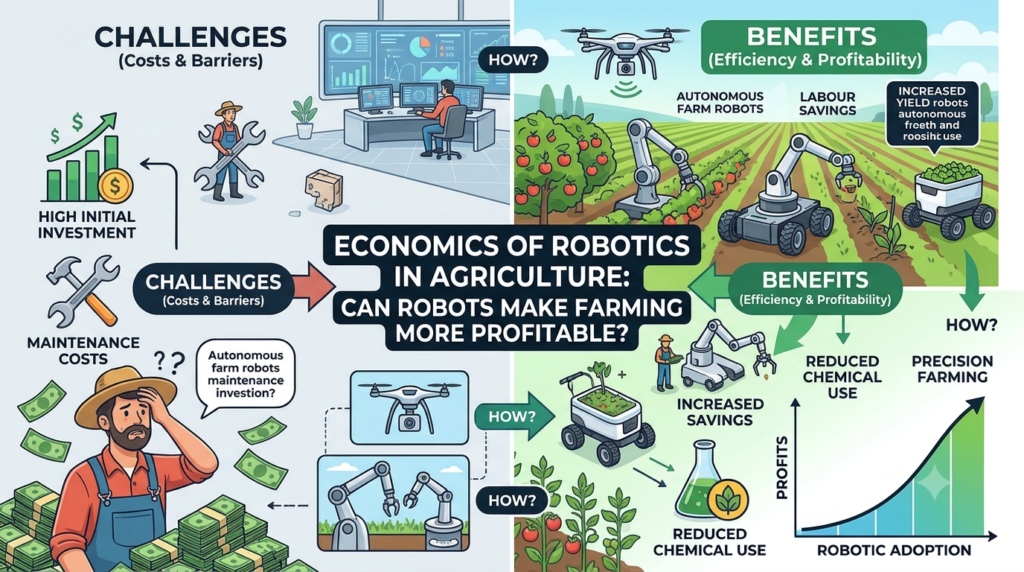
Can robotics actually make farming more profitable????
This is important for India because agriculture still depends heavily on human labour, while many farmers have small landholdings and limited money to invest in expensive machines. So, the success of agricultural robotics will not depend only on how advanced a machine is. It will depend on whether that machine can solve a real problem at a reasonable cost.
1. What Does Robotics Mean in Farming????
Agricultural robotics means using machines that can do farm work automatically or with limited human effort.
These machines can help with:-
Planting and sowing
Removing weeds
Spraying fertilisers and pesticides
Checking crop health
Detecting diseases
Harvesting
Sorting and grading crops
Monitoring soil and water
Feeding and milking animals
Drones are currently one of the easiest examples to understand. They can be used to spray agricultural inputs and can cover fields much faster than traditional manual methods.
Robotics, however, is much bigger than drones. In the future, farmers may also use machines that can identify a weed and remove only that weed instead of treating the whole field.
2. Why Is This Technology Becoming Important???
The cost of farming does not come from one thing.
A farmer has to manage labour, seeds, fertilisers, pesticides, diesel, irrigation, machinery and transportation. At the same time, weather can suddenly damage the crop.
This makes every saving important.
Robotics can help mainly in three ways:-
Less wastage + less time + better use of resources.
For example, if a machine applies an input only where it is needed, some unnecessary use can be avoided. If a machine completes a job quickly, the farmer can save time. If a crop problem is detected early, the farmer may be able to act before the damage becomes bigger.
So, the economic value of robotics is not only about increasing production. Saving money can be equally important.
3. The Labour Question:-
Labour is one of the biggest issues in agriculture.
During sowing and harvesting seasons, many farmers need workers at almost the same time. If workers are not available, farm operations can be delayed. In some places, higher labour costs also increase the cost of cultivation.
Robotics can reduce the need for manual work in repetitive and physically difficult activities.
But this does not automatically mean that robots will simply remove rural jobs.
A different kind of work can also grow.
Villages may need people who can:-
Operate drones
Repair agricultural machines
Maintain batteries
Provide machine-rental services
Handle farm data
Train other farmers
Manage automated equipment
So the bigger change may be from manual farm work to technical farm services.
4. A Small Farmer Cannot Buy Every Machine:-
This is probably the biggest economic challenge for India.
A large farmer may be able to buy an expensive machine because the machine can be used over a large area.
But imagine a farmer who owns only a few acres. Buying a costly robot may not make sense if it is used only a few times a year.
This is where the rental model becomes important.
Instead of every farmer owning a machine, one organisation or service provider can own it and rent it to several farmers.
The basic idea is simple:-
One machine – many farms – more use – lower cost per farmer.
This model can make modern technology more useful for small and marginal farmers.
5. Custom Hiring Can Make Robotics More Practical:-
India already has a system that supports shared access to farm machinery.
Under agricultural mechanisation programmes, Custom Hiring Centres and Farm Machinery Banks help farmers get machines on rent instead of requiring them to purchase everything themselves.
As of 2025–26, 27,554 Custom Hiring Centres had been established under the relevant agricultural mechanisation programme. The same programme had also supported 21.61 lakh agricultural machines for individual farmers between 2014–15 and 2025–26.
This is important for robotics because expensive technology becomes more practical when farmers can pay for its use instead of paying the full purchase price.
Example:- (Namo Drone Didi)
A good example of this changing model is the Namo Drone Didi programme.
The programme has a target of providing 15,000 drones to women Self-Help Groups, with an approved outlay of ₹1,261 crore for 2023–24 to 2025–26.
The selected groups can provide drone-based agricultural services to farmers. The government provides financial support of 80% of the drone package cost, up to ₹8 lakh, along with training for operating the drone.
By January 2026, 1,094 drones had been distributed to women Self-Help Groups by lead fertiliser companies, of which 500 were distributed under the Namo Drone Didi scheme.
The important point here is not simply the number of drones.
It is the business model.
A woman in a rural area can become a trained drone operator and provide a service to farmers. The farmer does not necessarily have to purchase the drone.
This creates a link between technology, farming and rural employment.
6. Robots Can Save More Than Labour:-
Sometimes the biggest benefit of a machine is not the worker it replaces. It is the waste it prevents.
Consider pesticide spraying.
If the application is poorly managed, too much input may be used in some areas and too little in others. A technology-based system can make application more controlled.
The same idea can be applied to water and fertilisers.
In simple terms:-
Better information – better decision – less unnecessary use.
This can reduce production costs and may also reduce pressure on soil and water resources.
However, the actual saving will depend on the crop, machine, field size, operator and local conditions. Robotics is not a magic solution that will reduce every farm cost automatically.
7. Timing Can Decide a Farmer’s Profit:-
Agriculture is very different from factory production.
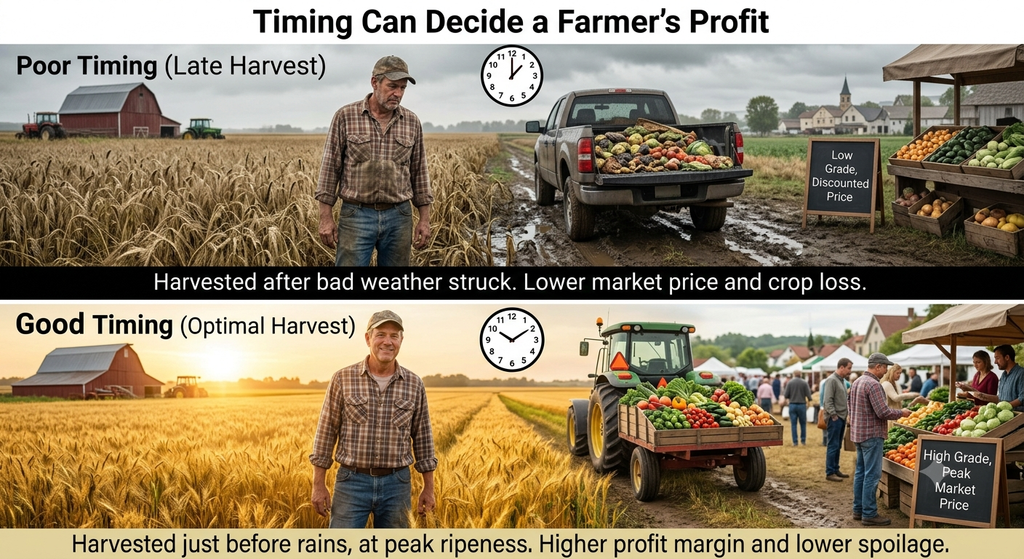
A factory can sometimes delay a task for a few hours or even a day. A farmer may not always have that choice.
If a pest attack is spreading, action may be needed quickly.
If harvesting is delayed, crop quality may fall.
If sowing is late, the entire crop cycle can be affected.
This is where machines can have a hidden economic value.
A robot that completes a task at the right time can sometimes be more valuable than a machine that simply does the same task cheaply.
In farming, time itself has a price.
8. Robotics and India’s Food Requirement:-
India needs to produce more food while dealing with limited land, water pressure and changing weather conditions.
India’s foodgrain production was estimated at 3,577.3 lakh metric tonnes in agricultural year 2024–25, which was 254.3 lakh metric tonnes higher than the previous year.
Robotics alone cannot create food security.
But it can support farming by helping with:-
Timely operations
Better crop monitoring
Lower input wastage
Faster spraying
Better use of labour
Early identification of crop problems
This makes robotics one part of a larger agricultural productivity system.
9. The Hidden Cost of a Robot:-
Buying a machine is not the only expense.
A farmer or service provider may also have to spend money on:-
Batteries
Repairs
Software
Training
Charging equipment
Spare parts
Maintenance
Insurance
Technical support
There can also be problems with internet connectivity, difficult terrain and different crop conditions.
A machine that works well on a large and flat farm may not perform in exactly the same way on a small field with uneven land.
So, cheap to buy does not always mean cheap to operate.
The complete cost of ownership must be considered.
10. What Happens to Rural Employment????
This is where the debate becomes more complicated.
If robots do repetitive work, some traditional farm jobs may decline.
But new jobs can appear around the technology.
For example, one drone can create demand for a trained operator, repair worker and service provider.
This means the rural economy may slowly move towards a different type of employment.
The real challenge is training.
If machines arrive but rural workers do not get the skills to operate them, the benefits may go mainly to companies or outside service providers.
Therefore, skill development must grow along with agricultural automation.
11. Technology Must Fit Indian Farms
India does not need technology simply because it is advanced.
It needs technology that works in Indian conditions.
A useful agricultural robot should ideally be:-
Affordable
Easy to operate
Easy to repair
Suitable for small farms
Useful for different crops
Available through rental services
Supported by local training
Strong enough for rural conditions
This is especially important because the average Indian farming situation is very different from a huge industrial farm.
The best machine is not always the most expensive machine.
The best machine is the one that gives the farmer value for money.
12. The Environmental Side of Robotics;-
The economic impact of robotics can also go beyond farm income.
If technology helps farmers use water, fertilisers and pesticides more carefully, it can reduce unnecessary use of resources.
This can have long-term benefits for:-
Soil health
Water resources
Farm productivity
Input costs
Environmental quality
For a country facing climate-related farming risks, better resource management can become an economic advantage.
13. What Should India’s Future Model Look Like????
A fully robotic farm is not the most realistic future for most Indian farmers.
A better model could be:-
Farmer + machine + data + human decision.
The farmer remains at the centre.
Machines can handle repetitive or difficult tasks. Sensors and data can provide information. The farmer can then decide what action is actually needed.
This approach can make technology useful without making farmers completely dependent on machines.
Conclusion:- (The Robot Is Useful Only When the Farmer Benefits)
The economics of agricultural robotics is not about putting more machines into fields.
It is about creating more value from farming.
If a robot saves time, reduces wastage, lowers labour pressure, improves the use of inputs or helps protect a crop, it can become a useful economic tool.
But if the machine is too expensive, difficult to repair or unsuitable for small farms, it may increase the farmer’s financial burden instead.
India therefore needs a practical approach based on rental services, Custom Hiring Centres, Self-Help Groups, farmer organisations, local training and affordable machines.
The future of farming may not be completely human and it may not be completely robotic either.
It will most likely be a combination of both.
The real success of agricultural robotics will not be measured by how many robots enter Indian farms. It will be measured by how much better the farmer’s economics becomes.