
Can Easier Payments Change Global Trade
When people think about international trade, they usually think about ships, factories, products and markets. But there is another important part of trade that is often less visible -the movement of money.
When a company in one country buys goods from another country, the payment may pass through banks, currency-conversion systems and different financial rules. This can make international payments slower and more expensive than domestic payments.
This is why the idea of a BRICS payment system has become economically important.
However, one point must be clear. BRICS has not created a single common currency or one fully unified payment system. The current work is focused on improving cross-border payments, increasing interoperability between payment systems and making greater use of local currencies. The 2025 BRICS Leaders’ Declaration supported continued work on the BRICS Cross-Border Payments Initiative.
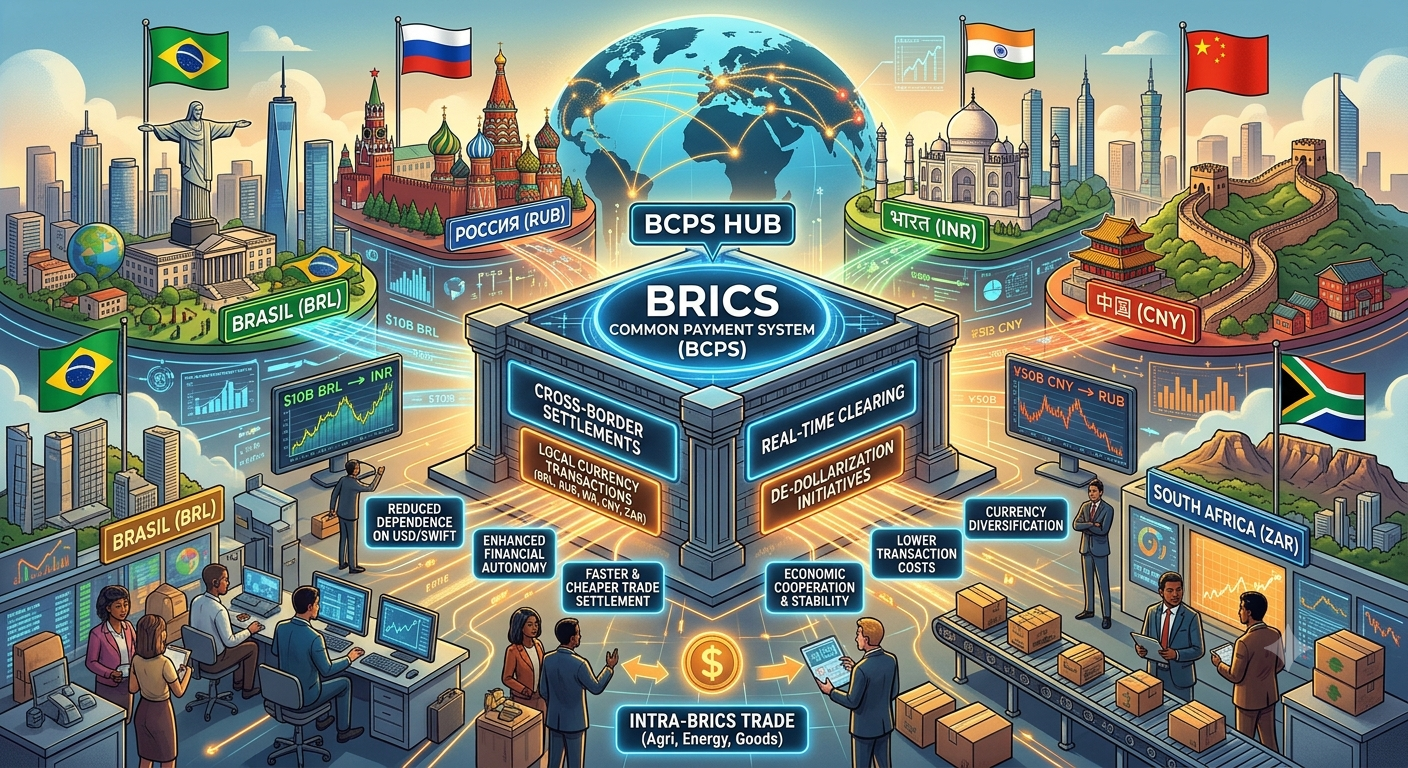
1. What Is the BRICS Payment Idea????
The basic idea is quite simple:- make it easier for money to move between BRICS countries.
Today, an international payment can involve several steps.
For example:-
A bank in the buyer’s country starts the payment.
Currency may need to be converted.
Another financial institution may help process the transaction.
The payment goes through compliance and security checks.
Finally, the seller receives the money.
Every additional step can add time or cost.
The BRICS payment initiative aims to explore better connections between national payment systems so that cross-border transactions can become faster, cheaper, safer and more efficient.
2. Why Do International Payments Cost More????
Domestic payments are generally easier because both sides operate under the same currency and financial system.
International payments are different.
A business may face:-
Currency conversion charges
Banking fees
Foreign-exchange risk
Settlement delays
Different financial regulations
Compliance requirements
For a large multinational company, these costs may be manageable.
For a small exporter, they can directly affect profit.
example:-
Suppose an Indian company exports machinery worth ₹10 lakh to a company in another BRICS country.
The Indian company expects to receive payment, but the money may involve currency conversion and several financial institutions before reaching its account.
If the payment process becomes more direct and efficient, the company could potentially save both time and money.
This shows why payment infrastructure is also an economic issue, not just a banking issue.
3. Local Currencies Can Give More Choices:-
One important part of BRICS financial cooperation is the greater use of local currencies in trade and financial transactions.
This does not mean that every international transaction will stop using major global currencies.
Instead, countries can explore more options.
For example, an Indian company and a Russian company may look at suitable arrangements for settling a transaction using the rupee and ruble, depending on the rules and financial arrangements available to them.
This can potentially reduce the need for an additional currency conversion.
But local-currency payments also have challenges. Exchange rates can change, and some currencies may not have enough international liquidity for large transactions.
So local currencies can provide more choices, but they cannot remove every financial risk.
4. India’s Digital Payment Experience Matters:-
India has already built a very large digital payment ecosystem.
According to NPCI’s official statistics, in August 2026, UPI recorded about 24.51 billion transactions with a total value of approximately ₹29.82 lakh crore. The system had 752 banks live on UPI during that month.
This is important when discussing international payment connectivity.
However, UPI and a possible BRICS cross-border payment arrangement are not the same thing.
Domestic payments are much easier because the participants operate within India’s financial system. International payments involve different currencies, laws, banks and regulatory authorities.
Still, India’s digital-payment experience provides useful technological experience.
example:-
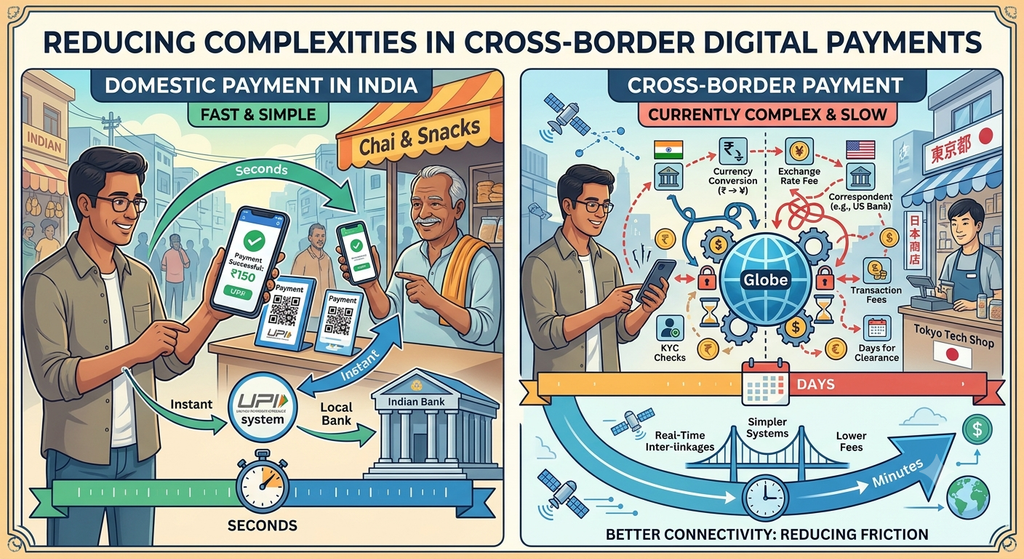
An Indian customer can scan a QR code and make a payment within seconds.
But if the customer is paying a business in another country, the transaction becomes more complicated because both countries may use different currencies and financial systems.
Better cross-border connectivity aims to reduce some of these difficulties.
5. Small Businesses Could Benefit:-
Large companies usually have dedicated teams for foreign exchange, banking and international transactions.
Small businesses often do not.
This makes payment costs more important for them.
A simpler cross-border payment environment could potentially help:-
MSMEs
Small exporters
Importers
Start-ups
Online service providers
Freelancers
Tourism businesses
example:-
Imagine a small Indian software company providing services to customers in another BRICS country.
If receiving international payments becomes faster and less expensive, the company may be able to serve more foreign customers without losing a large part of its earnings to payment-related costs.
Therefore, better payment systems can indirectly support small businesses and entrepreneurship.
6. Faster Payments Can Improve Cash Flow:-
Time has an economic value.
Suppose an exporter sends goods today but receives the payment several days later.
During that period, the business may still need money for:-
Salaries
Raw materials
Transport
Electricity
Rent
Loan payments
A faster settlement system can help businesses manage their cash more efficiently.
This can be particularly important for small companies because they usually have less financial cushion than large corporations.
So faster payments are not simply about convenience. They can influence the day-to-day financial health of a business.
7. Easier Payments Can Support Trade:-
BRICS includes large emerging economies with major markets and different economic strengths.
Trade between these countries covers many areas, such as:-
Energy
Agriculture
Pharmaceuticals
Machinery
Minerals
Infrastructure
Digital services
Consumer products
Payment systems do not create demand by themselves.
A Brazilian company will not buy an Indian product simply because payment becomes easier.
But if a company already wants to trade, a simpler payment process can remove one of the barriers.
The 2025 BRICS declaration connected work on efficient cross-border payments with the potential to support trade and investment flows.
8. BRICS Countries Have Different Financial Systems:-
Building a common payment network is not easy because BRICS countries are economically different.
They have different:-
Currencies
Banking regulations
Inflation conditions
Interest rates
Exchange-rate policies
Financial institutions
Digital-payment systems
A payment system that works smoothly in one country may need changes before it can connect with another country’s system.
This is why interoperability is important.
In simple words, different payment systems need to be able to communicate with each other safely and efficiently.
9. Cybersecurity Will Be a Major Test:-
Money cannot move through a digital network without strong security.
As payment systems become more connected, cybersecurity becomes more important.
A successful system would need:-
Strong user authentication
Fraud detection
Data protection
Reliable technology
Secure communication
Quick response to cyberattacks
Clear rules for payment disputes
A system that is fast but unsafe cannot build long-term trust.
Therefore, the goal should not be only faster payments.
It should be fast, safe and reliable payments.
10. Currency Risk Will Still Exist:-
A better payment system does not remove currency risk.
Suppose an Indian exporter agrees to receive payment in another country’s currency. If that currency falls in value before the payment is converted into rupees, the exporter may receive less money than expected.
This is known as foreign-exchange risk.
Therefore, even with better payment connections, businesses will still need to manage currency fluctuations.
This is an important limitation of the BRICS payment idea.
It can potentially reduce some payment-related costs and delays, but it cannot eliminate every risk associated with international trade.
11. What Could India Gain????
India could potentially benefit from better payment connectivity in several ways.
For exporters:-
Receiving international payments could become easier.
For MSMEs:-
Lower payment barriers could make foreign markets more accessible.
For importers:-
Businesses could have more options for international settlement.
For digital businesses:-
Cross-border services could become easier to manage.
For financial institutions:-
There could be opportunities for new payment and settlement services.
India’s large digital-payment ecosystem also gives its financial sector experience in handling high volumes of electronic transactions.
However, the actual benefits will depend on implementation, technical cooperation and the participation of banks and businesses.
12. Why a Common BRICS Currency Is a Different Question????
The idea of a common BRICS currency is often discussed separately from the payment initiative.
These are not the same thing.
A payment system can connect countries while allowing each country to continue using its own currency.
A common currency would require much deeper economic coordination.
Countries would have to deal with differences in:-
Monetary policy
Inflation
Interest rates
Fiscal policy
Exchange rates
Economic conditions
Therefore, improving cross-border payments is a much different task from creating a common currency.
The current official BRICS work on payments should not be described as the creation of a common BRICS currency.
13. What Could the Future Look Like????
A possible future arrangement could look something like this:-
Indian business – Indian payment system – connected cross-border network – foreign payment system – foreign business.
The two businesses could continue using their own national currencies where suitable arrangements exist.
The main change would be the payment infrastructure connecting them.
If this works efficiently, businesses may spend less time dealing with complicated payment procedures.
It could also encourage innovation and competition in international payment services.
14. The Main Challenges Ahead:-
The idea has economic potential, but several practical problems need to be solved.
Regulatory differences:- Countries have different financial rules.
Currency liquidity:- Local currencies need enough market liquidity for international transactions.
Technology:- Payment systems must communicate securely.
Trust:- Banks and businesses need confidence in the system.
Cybersecurity:- Financial networks must be protected from fraud and attacks.
Implementation:- Countries need common technical standards and practical procedures.
Because of these challenges, development is likely to take time.
Conclusion:- (The Real Value Is Easier Cross-Border Payments)
The economics of a BRICS payment system is not mainly about replacing one currency with another.
Its bigger idea is to make international money transfers faster, cheaper, safer and easier.
If payment connections improve, the benefits could reach much further than banks.
They could potentially help:-
Exporters
Importers
MSMEs
Start-ups
Digital businesses
Service providers
Consumers
For India, this discussion is especially relevant because the country already has a very large digital-payment ecosystem. UPI’s August 2026 figures show the scale of India’s domestic digital-payment infrastructure.
But the success of BRICS payment cooperation will ultimately depend on practical implementation.
The real question is not whether a new payment system sounds impressive.
The real question is whether an Indian business, a Brazilian trader, a Russian supplier or another BRICS participant can eventually move money across borders with less cost, less delay and more confidence.
If that happens, the economic importance of BRICS payment cooperation could extend beyond banking and become a useful part of international trade.