
Introduction:- A Difficult Economic Situation
Stagflation is a very serious economic problem. It happens when three things occur at the same time:-
Prices keep increasing (inflation)
Economic growth becomes slow
Unemployment rises
Normally, when growth is slow, prices do not rise much. And when prices rise, it usually means the economy is growing. But in stagflation, both problems happen together. That is why it is considered one of the toughest economic conditions for any country.
In 2026, many countries are facing slow growth with inflation still above comfortable levels. This has created pressure on people, businesses, and governments around the world.
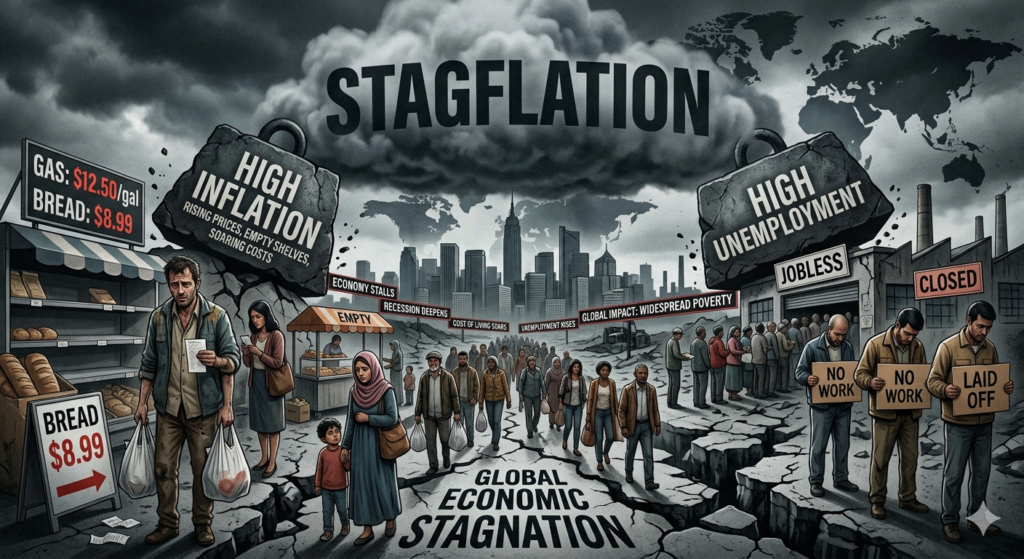
1. Common People Suffer the Most:-
The biggest impact of stagflation is on ordinary people.
When inflation is high, the prices of food, fuel, electricity, transport, rent, and daily goods increase. But at the same time, salaries do not increase much because economic growth is weak.
This creates a serious problem:-
Income stays almost the same
Expenses increase
Savings decrease
In many countries in 2026, inflation is still around 3–6% in several regions, while wage growth remains slow. Because of this, people feel that money finishes faster than before.
Middle-class families cut their extra spending. Poor families struggle to manage basic needs.
Simply put, life becomes expensive and stressful.
2. Rising Unemployment:-
When economic growth slows down, companies produce less. When production decreases, companies do not hire new workers. Sometimes, they even remove old employees to reduce costs.
This increases unemployment.
Young people suffer the most because they are searching for jobs for the first time. Small businesses also face problems because demand is low.
In 2026, many countries are experiencing moderate growth below their full potential. Because of this, job markets are not very strong.
When people lose jobs or fear losing them, they spend less money. This further slows down the economy.
3. Businesses Face Heavy Pressure:-
Stagflation creates problems for businesses.
On one side, production costs increase because:
Raw materials become expensive
Energy prices remain high
Transport costs rise
On the other side, customers reduce spending because they want to save money.
So businesses face a double problem:-
High costs + Low demand
Small and medium businesses suffer more because they do not have large savings. Some companies delay expansion plans. Some reduce workers. Some even shut down.
Profit margins become smaller, and uncertainty increases.
4. Government Policy Becomes Very Difficult:-
For governments and central banks, stagflation is very challenging.
Usually:-
To control inflation – interest rates are increased.
To increase growth – interest rates are reduced.
But during stagflation, both inflation and slow growth exist together.
If interest rates are increased:-
Loans become expensive
Investment decreases
Growth slows more
If interest rates are reduced:-
Inflation may rise again
So policymakers must take very careful and balanced decisions.
In 2026, many countries are trying to control inflation slowly while also supporting growth through infrastructure spending and targeted help for poor families. But it is not easy.
5. Impact on Global Trade:-
Stagflation does not affect only one country. It spreads to the whole world.
When big economies grow slowly:-
They import less
Exporting countries earn less
Global trade becomes weak
Developing countries suffer more because they depend on exports and foreign investment.
If global demand is low, factories produce less. If energy prices are high, import bills increase. This creates more pressure on weaker economies.
6. Financial Market Instability:-
Stagflation creates uncertainty in financial markets.
Investors become careful because:-
Growth is weak
Inflation is high
Future policies are unclear
Stock markets may become unstable. Currency values may fluctuate. Investors prefer safer investments instead of risky ones.
In 2026, financial markets in many regions show cautious behavior because long-term economic growth is still uncertain.
7. Increasing Inequality:-
One serious long-term effect of stagflation is rising inequality.
Rich people usually invest in assets like property or businesses, which may increase in value during inflation.
Poor people spend most of their income on food and fuel, whose prices rise quickly. They do not have extra money to invest.
Because wages do not grow equally for everyone, the gap between rich and poor increases.
This can create social tension and dissatisfaction if the situation continues for a long time.
8. Mental Stress and Fear:-
Economic problems also affect emotions.
When people see prices rising and jobs becoming uncertain, they feel worried about the future.
This reduces confidence. People avoid spending money. They delay buying houses, cars, or starting new businesses.
Fear and uncertainty slow down economic activity even more.
Stagflation affects not only money but also peace of mind.
9. Impact on Developing Countries:-
Developing countries face more difficulty during global stagflation because:-
They depend on imported oil and food
Their currencies are weaker
They rely on foreign investment
If global interest rates remain high, money flows out of developing countries. This makes their currency weaker and imports more expensive.
Many developing economies in 2026 are still managing high food prices along with slow growth, which makes government budgets tight.
10. Possible Long-Term Changes:-
Although stagflation is painful, it can also push countries to make improvements.
Governments may:-
Invest in renewable energy
Improve domestic production
Strengthen supply chains
Control unnecessary spending
Some countries are focusing on becoming less dependent on imports and more self-reliant.
If proper reforms are taken, the economy can become stronger in the long run.
Conclusion:- A Serious but Manageable Challenge
Stagflation is one of the toughest economic conditions because it combines rising prices and slow growth together.
Its main impacts are:-
Higher cost of living
Job insecurity
Weak business profits
Policy difficulties
Social stress
In 2026, the global economy is slowly trying to stabilize, but challenges still exist. The solution requires balanced policies, stable energy prices, controlled inflation, and support for growth.
Economic problems do not last forever. With careful planning and strong decisions, countries can overcome stagflation.
In simple words, stagflation teaches one important lesson:-
An economy needs both stable prices and steady growth to ensure a secure and comfortable life for its people.