
Gig Economy Expansion:- (Redefining the Future of Work)
Introduction:-
(A New Work Culture is Rising)
Imagine earning money on your own terms—no fixed office, no strict timings, and the freedom to choose your work. This is not just an idea anymore; it is the reality of today’s gig economy. Across the world, and especially in India, more and more people are moving towards flexible work instead of traditional 9-to-5 jobs.
The gig economy is not just changing how people work-it is changing how people think about work. It is opening doors for independence, creativity, and multiple income sources.
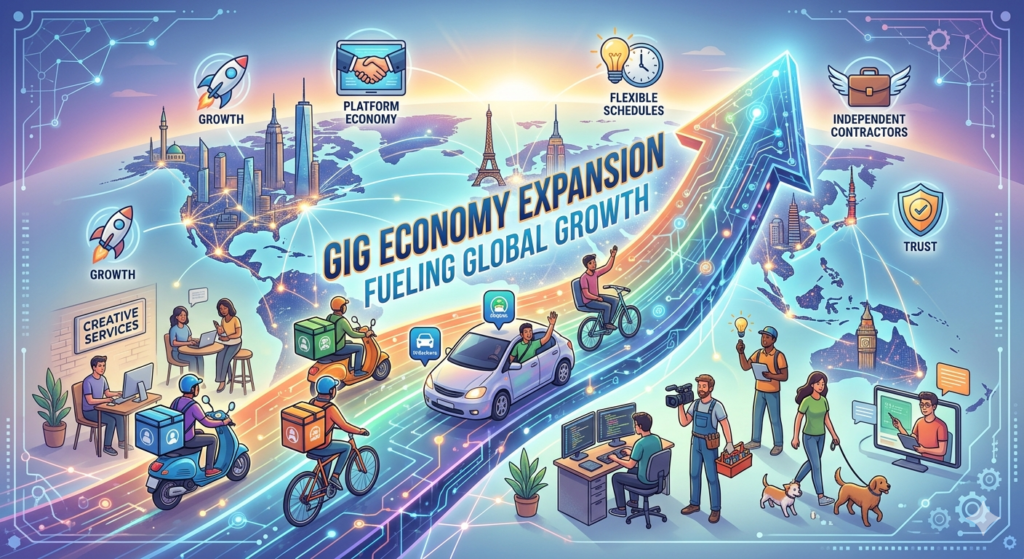
What is the Gig Economy
The gig economy is a system where people take up short-term, flexible jobs instead of permanent employment. These jobs are usually task-based or project-based, and workers are paid for each “gig” they complete.
Some common examples include:-
Delivery partners
Ride-sharing drivers
Freelance writers and designers
Online tutors and consultants
In simple words, gig workers are their own bosses. They decide when, where, and how much they want to work.
A Real-Life Example:-
Take the example of Rohan, a college student. He attends classes during the day and works as a delivery partner in the evening. On weekends, he also does freelance graphic design online. Through gig work, he manages his expenses without depending fully on his family.
This is the power of the gig economy-it fits into people’s lives instead of forcing people to fit into rigid job structures.
Growth of the Gig Economy in Recent Years:-
The gig economy has seen rapid growth in the last few years. After the pandemic, many people started looking for flexible work options, and businesses also began depending more on short-term workers.
In India, the number of gig workers is increasing steadily. A significant portion of the workforce is now engaged in gig or platform-based jobs, and this share is expected to grow further in the coming years.
This expansion is supported by:-
Increasing internet and smartphone usage
Growth of digital platforms
Rising demand for quick services
The gig economy is no longer a side option-it is becoming a major part of the employment system.
(Key Reasons Behind Its Expansion)
1. Flexibility and Independence:-
People today value freedom. Gig work allows them to choose their own schedule and workload. This is especially helpful for students, homemakers, and those looking for part-time income.
2. Digital Revolution:-
Technology has made it easier than ever to connect workers with customers. With just a mobile phone, people can find work instantly.
3. Lower Costs for Businesses:-
Companies save money by hiring gig workers instead of full-time employees. They don’t have to provide long-term benefits, which makes operations more efficient.
4. Changing Career Preferences:-
The younger generation prefers exploring multiple skills instead of sticking to one job. Gig work allows them to experiment and grow.
5. Need for Extra Income:-
Rising living costs have made it important for many people to have additional income sources. Gig work provides that opportunity.
(Different Types of Gig Work)
1. Platform-Based Jobs:-
These include delivery services, ride-sharing, and home services where work is assigned through mobile apps.
2. Freelancing:-
Skilled professionals like writers, designers, and programmers work on projects for different clients.
3. Temporary and Part-Time Roles:-
Companies hire workers for short periods during peak demand or special projects.
(Advantages of the Gig Economy)
1. More Job Opportunities:-
It creates employment for people with different skill levels, including those who may not find traditional jobs easily.
2. Skill Improvement:-
Working on different tasks helps individuals learn new skills and gain experience.
3. Multiple Income Streams:-
People can earn from more than one source, which increases financial security.
4. Better Work-Life Balance:-
Flexible working hours allow people to manage personal responsibilities along with work.
5. Encouragement to Entrepreneurship:-
Many gig workers gain confidence and eventually start their own businesses.
(Challenges That Cannot Be Ignored)
1. Lack of Job Security:-
There is no guarantee of regular work, which makes income uncertain.
2. Absence of Social Benefits:-
Most gig workers do not receive health insurance, paid leave, or retirement benefits.
3. Income Fluctuation:-
Earnings can vary from month to month, depending on demand.
4. Increasing Competition:-
As more people join, competition grows, which can reduce earning opportunities.
5. Limited Legal Protection:-
Many gig workers are still outside the full protection of labor laws.
Role of Government and Policy Support:-
Recognizing the importance of gig workers, efforts are being made to improve their conditions. There is a growing focus on:-
Providing social security benefits
Offering skill development programs
Bringing gig workers into formal systems
Such steps can make the gig economy more stable and secure in the long run.
Impact on the Overall Economy:-
The gig economy is contributing positively to economic growth
It generates employment at a large scale
It supports startups and small businesses
It increases consumer spending
It promotes digital development
By making work more accessible, it strengthens the economy and improves livelihoods.
Future of the Gig Economy:-
The future looks very promising. As technology continues to grow, more opportunities will be created in areas like digital services, remote work, and online platforms.
In the coming years:-
Skilled gig jobs will increase
Remote global work will expand
Worker protections will improve
More people will choose flexible careers
Gig work may soon become a normal part of everyone’s professional life.
Conclusion:- (A Shift That Cannot Be Ignored)
The gig economy is not just a temporary trend—it is a major shift in the way people work. It offers freedom, opportunity, and new ways to earn. At the same time, it also brings challenges that need attention.
With the right balance of flexibility and protection, the gig economy can become a powerful tool for growth and employment. It represents a future where work adapts to people’s lives, not the other way around.