
GST:- (The Tax Reform That Quietly Changed Everyday India)
A Simple Question That Started a Big Change
Have you ever noticed how a single bill today clearly shows the tax you pay??? This clarity was not always there. Earlier, taxes were hidden inside prices, confusing both buyers and sellers. India needed a cleaner, simpler, and more honest tax system. That need gave birth to Goods and Services Tax (GST)—a reform that reshaped how India earns, spends, and grows.
GST is not just about tax collection. It is about order replacing confusion, unity replacing fragmentation, and transparency replacing complexity.
What GST Really Means for a Common Person??
GST, or Goods and Services Tax, is an indirect tax applied to most goods and services we use daily—from a packet of biscuits to a mobile phone, from restaurant food to online services.
In very simple terms:-
You pay GST when you buy something
Businesses collect it
The government uses it for public development
The uniqueness of GST lies in the fact that the same tax system applies across the country, making India feel like one large marketplace.
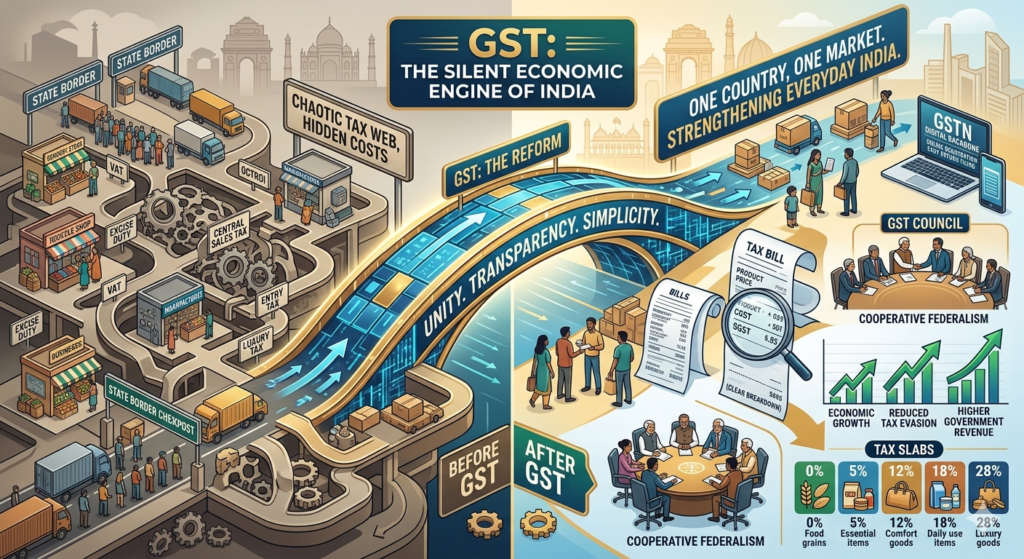
Before GST:- When Taxes Were a Maze
Before GST, India’s tax system looked like a tangled web. Different taxes were charged at different stages:-
Manufacturing
Transportation
Wholesale
Retail
Each stage added its own tax, and these taxes were charged on top of previous taxes. This made products costlier without adding real value. Businesses faced paperwork overload, and consumers paid more without knowing why.
GST entered as a clean-up reform, removing unnecessary layers and bringing clarity.
The Core Spirit of GST:- One Country, One Market
The soul of GST lies in one powerful idea—India should function as a single economic unit.
Earlier, moving goods from one state to another meant delays, check posts, and extra taxes. GST removed these artificial borders. Now, goods flow more freely, faster, and cheaper.
This reform helped India move from state-based economies to a national economy.
How GST Is Organised:- (A Smart Sharing System)
GST follows a smart dual structure to protect the financial rights of both the Centre and the States.
Central GST (CGST)
Collected by the Central Government on sales within a state.
State GST (SGST)
Collected by the State Government on the same sale.
Integrated GST (IGST)
Applied when goods or services move from one state to another.
This system ensures fair revenue sharing and maintains federal balance.
Tax Slabs Under GST:- (Designed With Social Balance)
GST does not treat all products equally—and that is intentional.
Essential items are taxed very lightly or not at all
Daily-use goods attract low tax
Comfort goods fall in mid slabs
Luxury and harmful items are taxed higher
This slab-based structure ensures that GST remains people-friendly, especially for lower-income groups.
Input Tax Credit:- Ending Tax on Tax
One of the most revolutionary ideas under GST is Input Tax Credit (ITC).
Earlier, businesses paid tax at every stage and could not recover it. Under GST:-
Tax paid on raw materials can be adjusted
Only value addition is taxed
Double taxation is removed
This feature encourages honest billing and brings more businesses into the formal economy.
A Digital Backbone:- GST Runs on Technology
GST is supported by a strong online system. Almost everything happens digitally:-
Registration
Return filing
Tax payment
Refund processing
This digital design:-
Reduces corruption
Saves time
Improves accuracy
Expands the tax base
Even small traders are gradually becoming part of a technology-driven system.
GST and Businesses:- (A New Way of Working)
GST changed business behavior across India.
What Improved???
Simpler tax structure
Easy inter-state trade
Lower transport costs
Better supply chain planning
What Was Challenging
Initial learning phase
Frequent updates
Compliance pressure for small firms
With time, most businesses adjusted and began enjoying long-term benefits.
Consumers and GST:- Paying With Awareness
GST brought something new for consumers visibility. Bills now clearly show how much tax is charged.
This transparency:-
Builds trust
Creates awareness
Reduces hidden pricing
In many cases, prices became more competitive due to reduced production costs.
GST’s Role in Strengthening the Economy
GST is not just a revenue tool; it is an economic stabilizer.
It has:-
Increased government revenue
Reduced tax evasion
Improved data-based policymaking
Encouraged formal employment
GST supports long-term economic planning and national growth.
GST Council:- Where Cooperation Shapes Policy???
The GST Council is a powerful example of teamwork between the Centre and the States. Decisions are taken collectively, not forcefully.
This cooperative approach:-
Reduces conflict
Builds consensus
Strengthens federal unity
It proves that economic reforms work best when governments work together.
Challenges:- (A System Still Growing)
GST is strong, but not perfect.
Some issues include:-
Too many tax slabs
Compliance complexity for small traders
Need for stable rules
These challenges are part of any large reform and can be improved with gradual adjustments.
Possibilities:- (GST’s Bigger Promise)
As systems improve and rules stabilize, GST has the power to:-
Boost manufacturing
Attract investment
Improve ease of doing business
Support India’s long-term growth vision
GST is not a finished product—it is an evolving reform.
Conclusion:- GST as India’s Silent Economic Engine
GST may not always make headlines, but it quietly powers India’s economic engine. By simplifying taxation, improving transparency, and uniting markets, GST has reshaped how India functions economically.
It is not just a tax reform—it is a foundation for a stronger, more organized, and more confident India.