
Fiscal Deficit:- (The Silent Force Shaping a Nation’s Economy)
Introduction:- Why Fiscal Deficit Matters to Everyone
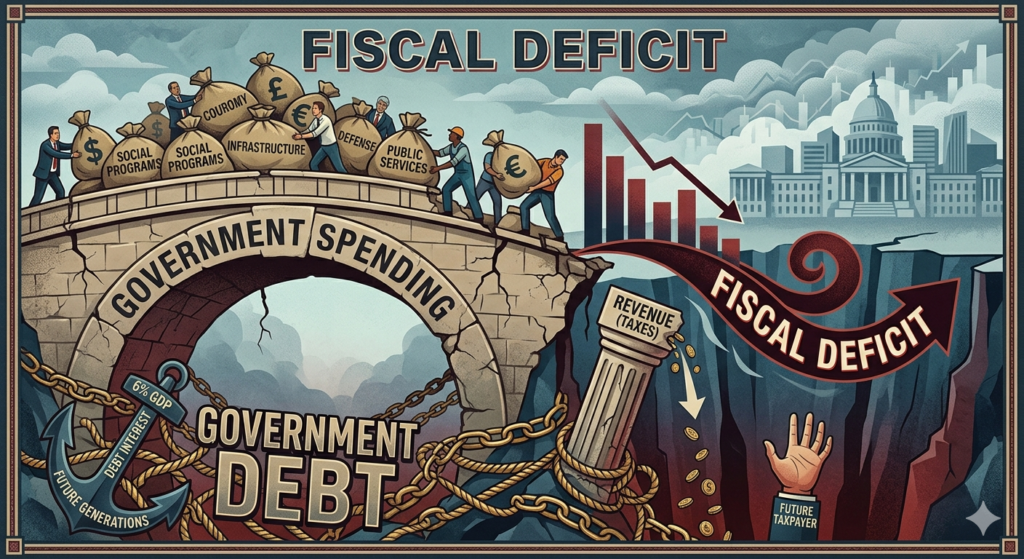
Fiscal deficit may sound like a technical term meant only for economists or policymakers, but in reality, it affects every citizen. From the quality of roads you travel on, the price of essential goods, to job opportunities and inflation — fiscal deficit quietly influences all of it. It represents the financial gap between what a government earns and what it spends, and how that gap is managed determines the future strength of an economy.
In a fast-growing country like India, fiscal deficit is not just a challenge; it is also a strategic tool. Understanding it helps us understand how development, welfare, and economic stability are balanced.
Understanding Fiscal Deficit in Simple Words:-
A fiscal deficit arises when the government’s total expenditure exceeds its total revenue, excluding borrowings. Simply put, when spending is higher than income, the government has to borrow money to meet its expenses — and this shortfall is called fiscal deficit.
It is usually measured as a percentage of GDP (Gross Domestic Product), which helps judge how large the deficit is in relation to the size of the economy. A higher percentage indicates greater dependence on borrowing, while a lower percentage reflects stronger fiscal discipline.
Why Governments Do Not Always Avoid Fiscal Deficit
Many people believe fiscal deficit is always bad. However, this is not entirely true. Governments often intentionally allow fiscal deficits to achieve important economic and social goals.
- Supporting Economic Growth:-
During slow economic phases, government spending boosts demand and prevents stagnation. Increased public investment can revive industries and create employment. - Building Long-Term Assets:-
Infrastructure projects like highways, railways, digital networks, and energy systems require massive investment. These expenses increase the deficit today but generate economic returns for decades. - Protecting the Vulnerable:-
Welfare schemes, subsidies, healthcare, and education spending ensure social stability. Cutting such spending sharply to reduce deficit may harm the poorest sections.
Thus, fiscal deficit is often a deliberate economic choice, not always a sign of weakness.
The Fiscal Deficit Equation — Explained Clearly
The concept can be understood with a simple logic:-
Fiscal Deficit = Total Government Spending − Total Government Income (excluding borrowings)
If government income falls short, borrowing fills the gap. The key issue is not borrowing itself, but how effectively borrowed money is used.
India’s Fiscal Deficit Story:- Where Do We Stand in 2025
India’s fiscal deficit has undergone major changes over the past few years.
After the pandemic, deficit levels rose sharply due to emergency spending.
Since then, the government has focused on gradual reduction, without compromising growth.
Current Position
For the financial year 2024-25, India’s fiscal deficit is estimated to be around 4.7–4.9% of GDP, showing a clear improvement from earlier years when it crossed 6%.
Future Target:-
For 2025-26, the government aims to reduce the fiscal deficit further to about 4.4% of GDP, indicating a strong commitment to fiscal consolidation while continuing capital investment.
This balanced approach signals stability to investors and strengthens India’s global economic credibility.
What Drives India’s Fiscal Deficit
Several structural and policy-related factors contribute to fiscal deficit in India:-
- Welfare and Subsidy Commitments:-
Food security, fertilizer subsidies, rural employment programs, and direct benefit transfers are essential but expensive. - Interest Payments:-
A large portion of government revenue goes toward paying interest on past loans, leaving less room for fresh development spending. - Revenue Fluctuations:-
Tax collections depend heavily on economic performance. Any slowdown directly impacts government income. - Infrastructure Expansion:-
India’s push for infrastructure-led growth requires heavy upfront spending, temporarily raising the fiscal deficit.
Fiscal Deficit and Economic Growth:- (A Delicate Balance)
Fiscal deficit and economic growth share a complex relationship.
Positive Impact
Government spending stimulates demand
Infrastructure boosts productivity
Job creation increases consumption
Potential Risks
Excessive borrowing can raise interest rates
Higher deficits may fuel inflation
Long-term debt burden can restrict future budgets
The challenge lies in maintaining the right balance — spending enough to grow, but not so much that debt becomes unmanageable.
Does Fiscal Deficit Always Lead to Inflation????
Not necessarily. Fiscal deficit causes inflation only under certain conditions, such as:-
When demand rises faster than supply??
When deficit is financed through excessive money creation??
When supply-side constraints exist??
If deficit spending is directed toward increasing productive capacity, inflationary pressure remains controlled. This is why quality of expenditure matters more than size.
Fiscal Discipline vs Development Needs:-
One of the biggest policy debates is whether to prioritize fiscal discipline or development spending.
Too much discipline may slow growth and hurt welfare
Too much spending may destabilize public finances
India’s current fiscal approach reflects a middle path — reducing deficit gradually while protecting capital expenditure and essential welfare schemes.
Global Perspective:- How India Compares
Globally, many advanced economies operate with higher fiscal deficits, especially during economic stress. However, emerging economies like India must be more cautious due to limited fiscal space and higher borrowing costs.
India’s steady deficit reduction path enhances:-
Investor confidence
Currency stability
Sovereign credit outlook
This improves India’s position in global financial markets.
Possibilities :-A Sustainable Fiscal Strategy
India’s future fiscal strategy focuses on:-
Improving tax efficiency
Expanding the formal economy
Controlling non-productive expenditure
Increasing asset-creating capital spending
Managing debt-to-GDP ratio effectively
The shift toward long-term fiscal sustainability, rather than short-term deficit targets alone, marks a mature approach to economic governance.
Conclusion:- (Fiscal Deficit — Not a Villain, but a Responsibility)
Fiscal deficit is neither a villain nor a magic solution. It is a powerful economic instrument that must be handled with care. When used wisely, it accelerates development, supports growth, and improves lives. When mismanaged, it burdens future generations.
India’s current fiscal path reflects caution, ambition, and balance. Understanding fiscal deficit helps citizens engage better with economic debates and appreciate how national priorities are funded.
In the end, fiscal deficit is not just about numbers — it is about choices, priorities, and the economic future of a nation.