
How India Designs Its Annual Budget:-( Inside the Nation’s Biggest Financial Plan)
India’s Annual Budget is not prepared overnight. It is the result of months of thinking, planning, discussions, and careful decision-making. Every year, the government prepares this budget to decide how money will be earned, where it will be spent, and which sectors will get priority.
The Annual Budget:- More Than Just Numbers
The Union Budget is the government’s official financial plan for one financial year, which runs from April 1 to March 31. It shows the estimated income and expenditure of the central government.
In the present time, the budget is also a vision document. It reflects:-
Economic priorities
Development goals
Welfare commitments
Growth strategy for the future
That is why budget preparation is treated as a national-level exercise.
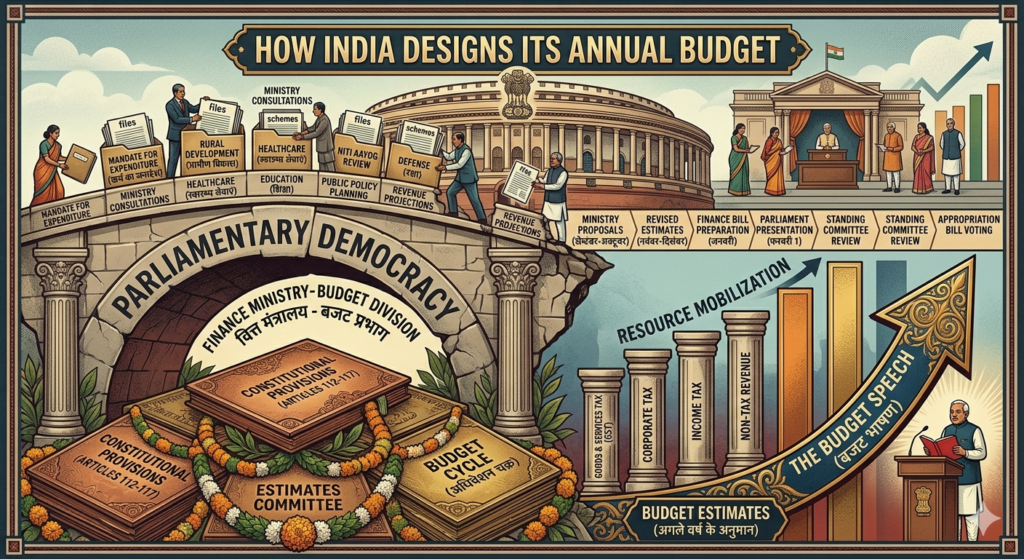
Who Takes Charge of Budget Preparation???
The main responsibility of preparing the budget lies with the Ministry of Finance. The process is led by the Finance Minister, but many departments work together behind the scenes.
Key institutions involved include:-
Department of Economic Affairs
Department of Revenue
Department of Expenditure
NITI Aayog
Experts, economists, and senior officials support the process with analysis and data.
Budget Planning Starts Early, Not at the Last Moment:-
Budget preparation usually begins around August or September, several months before its presentation. At this stage, the Finance Ministry sends guidelines to all central ministries and departments.
These guidelines ask ministries to:-
Review past spending
Assess current needs
Plan future projects
This early start helps the government avoid rushed decisions.
Ministries Calculate Their Financial Needs:-
Each ministry prepares a detailed estimate of how much money it will need in the next year. These demands are based on:-
Existing schemes
New policy goals
Rising costs
Long-term development plans
For example:-
Infrastructure ministries focus on roads, railways, and digital connectivity
Social ministries prioritize health, education, and nutrition
Economic ministries focus on growth, investment, and employment
All proposals must justify why funds are needed.
Knowing the Income Side:- How Much Can the Government Earn???
Along with spending plans, the government carefully estimates its expected income. This is a very important step because spending decisions depend on income capacity.
Major income sources include:-
Income tax and corporate tax
Goods and Services Tax (GST)
Customs and excise duties
Dividends from public sector companies
Non-tax receipts like fees and interest
In recent years, revenue estimation has become more realistic and data-based to avoid financial stress later.
Listening to States, Industries, and Citizens:-
Modern budget preparation involves wide consultation. The central government regularly holds meetings with:-
State governments
Industry representatives
Farmers’ groups
Economists and policy thinkers
These discussions help the government understand real-world problems such as inflation pressure, employment needs, and sector-specific challenges.
This consultative approach makes the budget more inclusive and balanced.
Managing Growth Without Losing Financial Control:-
One of the toughest tasks in budget preparation is balancing development needs with financial discipline.
On one hand, the government needs to:-
Spend more on infrastructure
Support poor and vulnerable groups
Promote manufacturing and innovation
On the other hand, it must:-
Control fiscal deficit
Avoid excessive borrowing
Maintain economic stability
This balance is crucial for long-term growth and investor confidence.
Economic Survey:- (Setting the Background)
Before finalizing the budget, the government releases the Economic Survey. This document reviews the performance of the Indian economy in the previous year.
The Economic Survey:-
Studies growth trends
Highlights risks and opportunities
Suggests future policy direction
It acts as a guidebook for the budget and helps align spending with economic reality.
Final Checks and Tough Decisions:-
Once all data is collected, several rounds of internal discussions take place in the Finance Ministry. Officials examine:-
Which sectors need more support
Where spending can be reduced
How tax changes may affect citizens
At this stage, many tough choices are made to ensure the budget remains practical and effective.
The Halwa Ceremony:- (A Symbol of Completion)
A unique tradition in India’s budget process is the Halwa Ceremony. It marks the final stage of budget preparation.
After this ceremony:-
Budget documents are locked
Officials involved follow strict confidentiality
No information is shared outside
This ensures fairness and transparency.
Digital Era Budget:- (Technology Takes the Lead)
In recent years, budget preparation has become more digital. Earlier, thousands of printed documents were required. Today:-
Budget documents are prepared digitally
Citizens can access them online instantly
Transparency has improved
This digital shift has made the budget more accessible and environment-friendly.
Budget Day:- (Presenting the Plan to the Nation)
The Finance Minister presents the Union Budget in the Lok Sabha, usually on February 1. This early presentation gives enough time for parliamentary discussion before the new financial year begins.
The budget speech highlights:-
Major policy announcements
Tax reforms
Development priorities
Economic vision
After the speech, budget documents are released to the public.
Parliament’s Role:- (Debate, Review, Approve)
After presentation, Parliament examines the budget in detail. Members of Parliament:-
Debate proposals
Ask questions
Suggest improvements
Demands for grants are voted on, and once approved, the Finance Bill becomes law.
This step ensures democratic control over public money.
Turning Plans into Action:-
After approval, ministries receive funds and begin implementation. The government monitors:-
Progress of schemes
Quality of spending
Outcomes on the ground
Performance-based monitoring has become more important in recent years.
Why the Budget Matters to Every Citizen???
The annual budget affects daily life in many ways:-
Tax rates decide savings
Spending impacts jobs and services
Welfare schemes support the needy
A well-prepared budget helps create growth, stability, and trust.
Conclusion:- (A Carefully Crafted Financial Blueprint)
India’s annual budget is the result of months of planning, consultation, and analysis. It combines economic logic with social responsibility.
From early planning to final approval, every step is designed to ensure that national resources are used wisely. In today’s dynamic economy, the budget is not just a financial statement — it is India’s roadmap for growth, inclusion, and future progress.