
Inflation in India:- (The price story behind every rupee)
Introduction:-
Inflation is one of the most important indicators of an economy’s health. It directly affects the cost of living, purchasing power of people, business decisions, and government policies. In simple terms, inflation refers to a sustained rise in the general level of prices of goods and services over time.
In a developing country like India, inflation has a dual impact. On one hand, moderate inflation supports economic growth. On the other hand, high or very low inflation can disturb economic stability. Therefore, understanding inflation is crucial for evaluating India’s economic performance and policy choices.
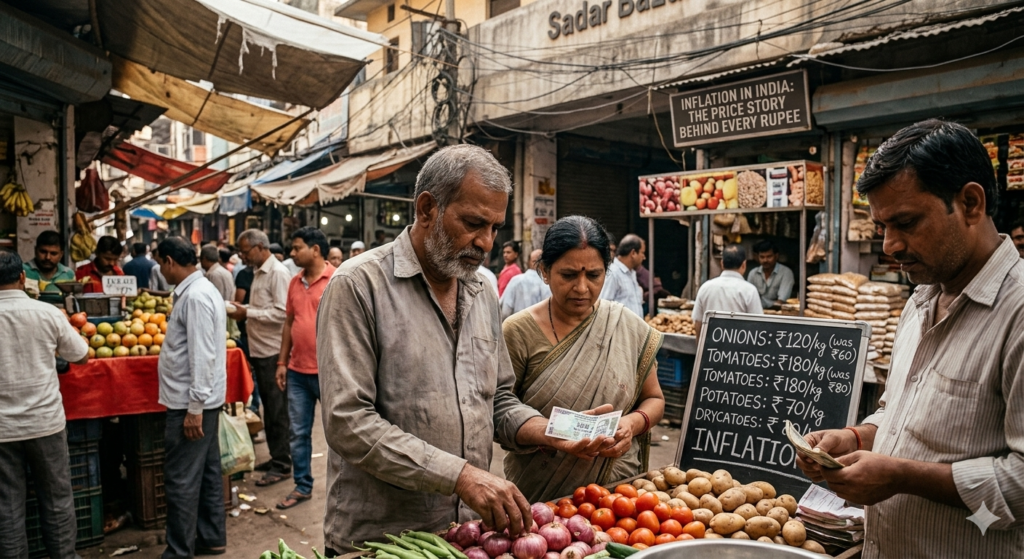
What Is Inflation???
Inflation occurs when too much money chases too few goods, leading to a rise in prices. As inflation increases, the value of money falls, meaning people need to spend more money to buy the same goods and services.
Inflation is not a one-time increase in prices. It is a continuous process that reflects deeper changes in demand, supply, production costs, and policy decisions.
Measurement of Inflation in India:-
India mainly measures inflation through the following indices:-
- Consumer Price Index (CPI):-
CPI measures changes in prices of goods and services consumed by households such as food, fuel, housing, education, and healthcare. It reflects the actual burden on common people and is the primary index used by the Reserve Bank of India (RBI) for policy decisions. - Wholesale Price Index (WPI):-
WPI measures price changes at the wholesale or producer level. It captures price movements before goods reach consumers and helps understand inflationary pressure on industries.
Among the two, CPI is more relevant for governance and welfare policies.
Recent Inflation Trends in India (2024–25):-
In recent times, India has witnessed a sharp decline in inflation, reaching historically low levels during parts of 2025. Retail inflation fell well below the RBI’s comfort range of 2–6 percent.
This unusual trend has drawn attention because:-
Inflation declined mainly due to falling food prices
Core inflation (excluding food and fuel) also remained soft
Purchasing power of households improved temporarily
While low inflation provides relief, it also raises concerns about weak demand and slowing economic momentum.
Major Causes of Inflation in India:-
- Food Price Movements:-
Food inflation plays a dominant role in India because a large share of household income is spent on food. Prices of cereals, pulses, vegetables, milk, and edible oils strongly influence overall inflation.
Good agricultural output reduces inflation
Poor monsoon or supply disruptions increase inflation
In recent times, improved supply and better management helped reduce food inflation significantly. - Demand and Supply Factors:-
Inflation rises when demand grows faster than supply. Rapid urbanisation, population growth, and rising incomes can increase demand for goods and services.
At the same time, supply constraints such as:-
Poor infrastructure
Logistics inefficiencies
Energy shortages
can push prices upward.
Balanced demand and efficient supply are key to price stability. - Cost-Push Inflation:-
When the cost of production rises, producers pass the burden to consumers. Factors include:-
Increase in fuel prices
Rising wages
Higher raw material costs
Global commodity price shocks
India is particularly sensitive to global crude oil prices, as it imports most of its energy needs. - Monetary Factors:-
Excess money supply in the economy can lead to inflation. If credit grows rapidly without corresponding growth in production, inflationary pressure builds up.
This is why central banks carefully manage interest rates and liquidity. - Global Influences:-
Inflation in India is increasingly influenced by global factors such as:-
International oil prices
Supply chain disruptions
Geopolitical conflicts
Global inflation trends
In an interconnected world, domestic inflation cannot be seen in isolation.
Role of the Government in Managing Inflation
The government uses fiscal and administrative measures to control inflation:-
Reducing taxes on essential goods
Releasing buffer food stocks
Import-export policy adjustments
Price monitoring mechanisms
Supporting farmers and supply chains
These steps aim to stabilize prices without harming growth.
Role of the Reserve Bank of India (RBI):-
The RBI plays a central role in inflation control through monetary policy.
Inflation Targeting Framework
India follows a flexible inflation targeting system with:-
Target:- 4 percent
Tolerance band:- 2–6 percent
Policy Tools Used by RBI:-
Repo rate adjustments
Open market operations
Liquidity management
Forward guidance
When inflation is high, RBI tightens policy. When inflation is low, RBI may adopt accommodative measures to support growth.
Impact of Inflation on the Indian Economy:-
- Impact on Households:-
High inflation reduces purchasing power
Low inflation provides temporary relief
Uncertainty affects savings and consumption - Impact on Poor and Vulnerable Sections:-
Inflation hurts the poor the most because:-
A large part of income is spent on essentials
Wages adjust slowly
Social security coverage is limited
Food inflation has direct welfare implications. - Impact on Businesses:-
High inflation increases costs and uncertainty
Low inflation may reduce profit margins
Stable inflation encourages investment - Impact on Economic Growth:-
Moderate inflation supports growth
Very high inflation discourages investment
Very low inflation may signal weak demand
Thus, price stability is essential for sustainable growth.
Challenges in Controlling Inflation in India:-
Dependence on monsoon-based agriculture
High share of food in consumption basket
Global price volatility
Structural supply constraints
Balancing growth and price stability
These challenges make inflation management complex in India.
Way Forward:- (Ensuring Price Stability)
To maintain healthy inflation levels, India needs a multi-pronged approach:-
Strengthening agricultural supply chains
Improving storage and logistics
Reducing dependence on imports
Enhancing productivity
Effective coordination between fiscal and monetary policy
Building buffers against global shocks
Long-term structural reforms are as important as short-term policy actions.
Conclusion:-
Inflation is not merely an economic number; it reflects the everyday reality of people. India’s recent experience of very low inflation highlights both opportunities and risks. While consumers benefit from stable prices, prolonged low inflation can weaken economic momentum.
The real challenge lies in maintaining moderate, stable, and predictable inflation that supports growth while protecting vulnerable sections. With prudent policies, strong institutions, and structural reforms, India can achieve price stability along with inclusive economic development.