
Industrial Growth in India:- (The Silent Engine of Economic Transformation)
Introduction:- Why Industry Matters for India
India’s economic journey cannot move forward without strong industrial growth. While agriculture provides livelihood to millions and the service sector leads in income generation, industries create the real foundation for long-term development. Industries convert raw materials into finished goods, create mass employment, strengthen exports, and reduce dependence on imports.
For a country like India, with a large population and rising aspirations, industrial growth is not a choice but a necessity. In recent years, India has taken several policy steps to strengthen its industrial base and position itself as a global manufacturing destination.
Understanding Industrial Growth in Simple Terms:-
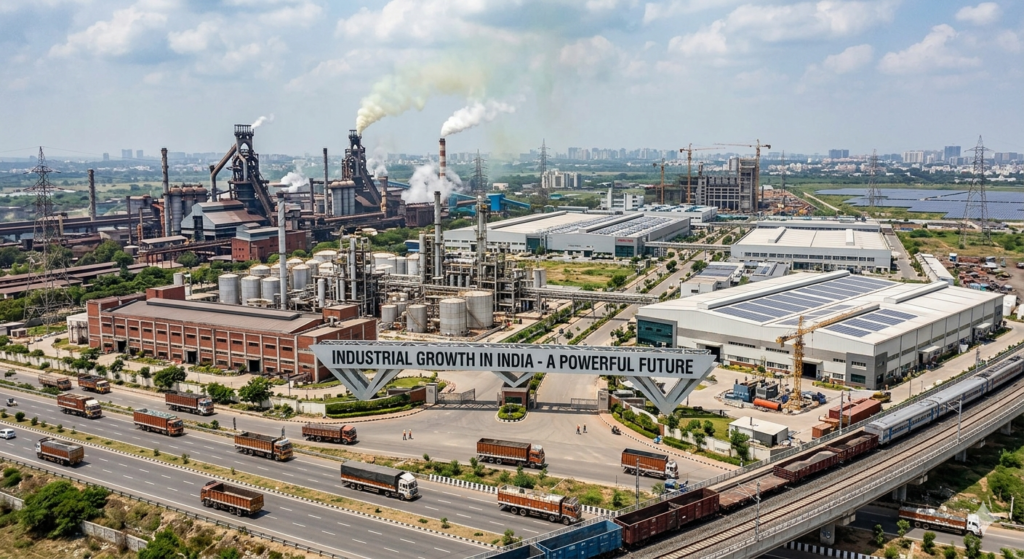
Industrial growth refers to the expansion of activities related to production and power generation. It mainly includes three sectors:-
Manufacturing.
Mining.
Electricity and energy.
When these sectors grow, production increases, investment rises, new jobs are created, and economic stability improves. Industrial growth also supports infrastructure, urban development, and technological progress.
In simple words, a strong industrial sector makes an economy productive, competitive, and self-reliant.
Present Status of Industrial Growth in India:-
India’s industrial sector has shown gradual improvement in recent years. Despite global uncertainty, supply chain disruptions, and inflationary pressures, industrial activity has remained resilient.
Manufacturing has emerged as the main driver of industrial growth, supported by government incentives, domestic demand, and infrastructure expansion. Power generation has also improved, ensuring energy availability for industries.
Although growth is not uniform every month, the overall trend indicates recovery and long-term potential. India is slowly shifting from being a consumption-based economy to a production-oriented economy.
Manufacturing Sector:- (The Core of Industrial Expansion)
The manufacturing sector is the heart of industrial growth in India. It produces a wide range of goods such as automobiles, electronics, machinery, textiles, chemicals, and pharmaceuticals.
Why Manufacturing Is Important????
Creates large-scale employment.
Increases value addition.
Boosts exports.
Reduces import dependence.
Encourages technological innovation.
India’s large domestic market, affordable workforce, and improving infrastructure give it a natural advantage in manufacturing. Government initiatives have further strengthened this sector by attracting investment and encouraging local production.
Mining Sector:- (Supplying the Industrial Raw Material)
Mining plays a supportive but crucial role in industrial growth. It provides raw materials such as coal, iron ore, bauxite, and other minerals required for steel, cement, power, and manufacturing industries.
While the sector faces challenges related to environmental concerns and regulatory delays, policy reforms aim to improve transparency, efficiency, and private participation. A balanced approach is needed to ensure both economic growth and environmental protection.
Power and Energy:- (Fuel for Industrial Activity)
No industry can function without reliable energy. The power sector is therefore a key pillar of industrial growth.
India has expanded its electricity generation capacity significantly, with a strong focus on renewable energy sources like solar and wind. This ensures stable power supply while supporting sustainable development.
Affordable and uninterrupted energy increases productivity, lowers costs, and makes Indian industries globally competitive.
Government Policies Driving Industrial Growth :-
Make in India:- (Manufacturing for the World.)
The Make in India initiative aims to transform India into a global manufacturing hub. It encourages companies to manufacture in India by simplifying rules, improving infrastructure, and promoting ease of doing business.
This initiative has increased foreign investment and improved India’s image as a production destination.
Production Linked Incentive (PLI) Scheme:-
The PLI scheme rewards companies based on their production performance. It focuses on key sectors such as electronics, pharmaceuticals, textiles, automobiles, and renewable energy equipment.
The scheme promotes scale, efficiency, and global competitiveness, while encouraging companies to expand manufacturing capacity within India.
Atmanirbhar Bharat-: (Towards Self-Reliant Industry)
The vision of Atmanirbhar Bharat focuses on strengthening domestic industries so that India can meet its own needs while remaining connected to global markets.
It emphasizes innovation, local value chains, MSME support, and reduced import dependence.
Role of MSMEs in Industrial Growth::-
Micro, Small, and Medium Enterprises (MSMEs) form the backbone of India’s industrial sector. They:-
Generate employment.
Support large industries.
Promote regional development.
Encourage entrepreneurship.
Government support through credit facilities, digital platforms, and market access has improved the resilience of MSMEs, making them key contributors to industrial growth.
Industrial Growth and Employment Generation:-
One of the biggest benefits of industrial growth is job creation. Industries provide employment to skilled, semi-skilled, and unskilled workers.
Manufacturing clusters and industrial zones help absorb surplus labor from agriculture and reduce rural-urban inequality. Employment generation also improves income levels and boosts domestic demand.
Industrial Growth and Export Expansion:-
Industrial products form a major share of India’s exports. Growth in manufacturing increases export capacity and earns foreign exchange.
A strong export base improves trade balance, strengthens the currency, and increases India’s presence in global markets. Export-oriented industries also adopt higher quality standards and modern technologies.
Key Challenges to Industrial Growth:-
Despite positive trends, industrial growth in India faces several challengesHigh Cost of Production.
Rising costs of raw materials, logistics, and energy affect industrial profitability.
Global Economic Uncertainty.
Slow global demand and geopolitical tensions impact exports and investment.
Environmental Sustainability.
Industrial pollution and resource depletion raise serious concerns. Sustainable industrial practices are essential for long-term growth.
Skill Mismatch.
Industries require skilled manpower, but gaps in training and education still exist.
Way Forward:- (Strengthening India’s Industrial Future)
To sustain industrial growth, India must focus on:-
Skill development aligned with industry needs.
Green and sustainable manufacturing.
Innovation and research.
Strong infrastructure and logistics.
Supportive policies for MSMEs.
Digital transformation of industries.
Public-private partnerships and state-level reforms will play a key role in achieving these goals.
Future Outlook:- (India as a Global Industrial Power)
India’s industrial future is promising. Rising domestic demand, infrastructure expansion, digital adoption, and new sectors such as electric vehicles, renewable energy, defense manufacturing, and electronics offer immense opportunities.
With consistent reforms and investment, India can emerge as a strong and competitive industrial economy in the coming decades.
Conclusion:- Industry as the Pillar of Economic Strength
Industrial growth is the silent engine that drives India’s economic transformation. It supports employment, exports, technology, and self-reliance. While challenges remain, India’s policy direction and economic potential provide a strong foundation for sustained industrial development.
A balanced, inclusive, and sustainable industrial strategy will ensure that industrial growth continues to shape India’s economic future in a positive and lasting way.