
Indian Labour Market Challenges
Introduction:-
The labour market is a crucial part of any economy because it connects people who are willing to work with employers who need workers. In a country like India, where the population is very large and continuously growing, the labour market plays an even more important role in shaping economic growth and social development.
India currently has one of the largest working-age populations in the world. A large share of the population is young and entering the labour force every year. This situation is often described as a demographic advantage because a young workforce has the potential to increase productivity and support economic expansion. However, this advantage can only be realized if sufficient employment opportunities are available.
Despite economic progress in recent years, the Indian labour market continues to face several structural challenges. Issues such as unemployment, skill mismatch, informal employment, and low female labour force participation create obstacles for inclusive growth. Addressing these challenges is important for ensuring that economic development benefits a larger section of society.
Rapid Growth of the Workforce:-
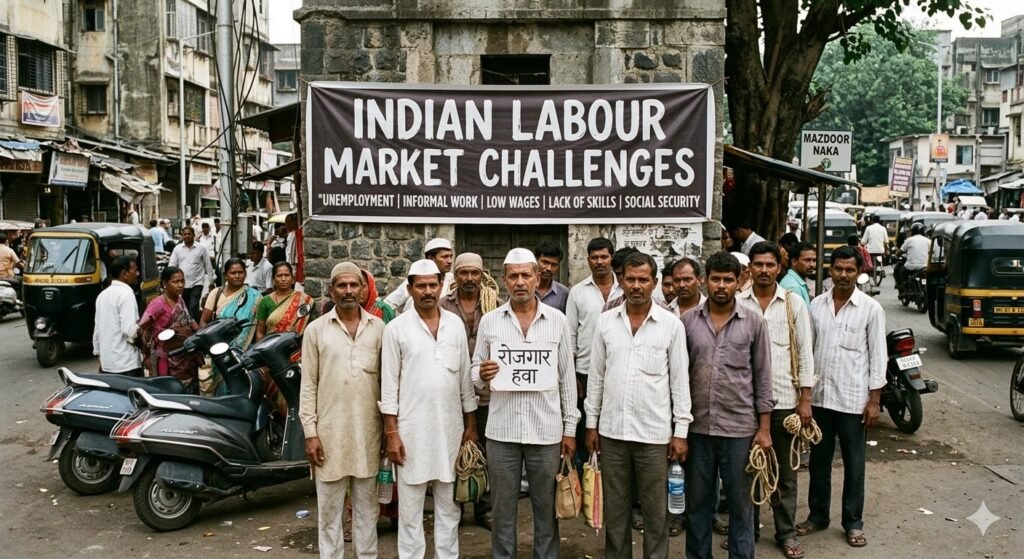
One of the key characteristics of the Indian labour market is the rapid expansion of the workforce. Every year millions of young people complete their education and start searching for employment opportunities. According to recent labour estimates, the working-age population continues to grow steadily, increasing the demand for new jobs across different sectors.
This growing workforce can contribute significantly to economic development if productive employment opportunities are created. However, when job creation does not keep pace with the increasing number of job seekers, it leads to rising competition for limited employment opportunities.
Many young people today aim for stable jobs in government or the formal sector, but such positions are limited. As a result, a large number of applicants compete for a small number of vacancies, highlighting the pressure on the labour market.
Unemployment and Underemployment:-
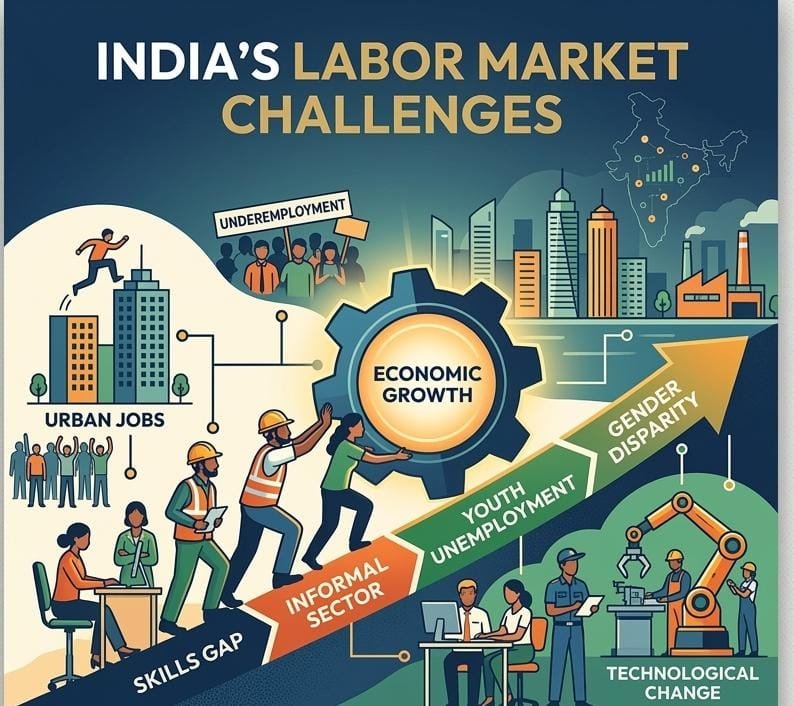
Unemployment remains one of the most visible challenges in the Indian labour market. Although employment levels vary across sectors and regions, youth unemployment continues to be a serious concern.
A significant number of educated individuals struggle to find jobs that match their qualifications and expectations. In many cases, graduates from universities spend a long time searching for employment, particularly in specialized fields.
Another related issue is underemployment. This occurs when individuals are employed but are not able to use their full potential or work sufficient hours. For example, in rural areas many people depend on seasonal agricultural work. During the off-season, they may remain partially unemployed or shift to low-paying activities.
Some important concerns related to unemployment include:-
High unemployment among educated youth
Long waiting periods for secure jobs
Limited employment opportunities in certain regions
These problems not only affect individual income but also reduce the overall productivity of the economy.
Skill Gap in the Labour Market:-
The gap between the skills possessed by workers and the skills required by employers is another major challenge. In recent years, industries have increasingly demanded workers with technical knowledge, digital skills, and practical experience.
However, many job seekers lack these abilities because the education system often emphasizes theoretical learning rather than practical training. As a result, employers sometimes find it difficult to recruit workers who meet their requirements, even when a large number of people are looking for jobs.
The skill gap becomes more visible in sectors such as manufacturing, technology, and modern services where specialized skills are necessary. Without proper training and skill development, workers may struggle to adapt to changing job requirements.
Strengthening vocational education and improving industry-oriented training programs can help reduce this gap and make the workforce more competitive.
Dominance of Informal Employment:-
A distinctive feature of the Indian labour market is the large presence of informal employment. A significant proportion of workers are engaged in jobs that do not offer formal contracts, job security, or social protection.
Workers in the informal sector include street vendors, construction labourers, domestic workers, and employees of small businesses. These jobs usually provide low and irregular income and often lack benefits such as health insurance, paid leave, or pension schemes.
The dominance of informal employment creates several economic and social challenges:-
Workers face income instability
Lack of access to social security benefits
Limited protection against workplace risks
Few opportunities for long-term career growth
Expanding formal employment opportunities is important for improving job quality and providing greater economic security to workers.
Low Female Labour Force Participation:-
Another major issue in the Indian labour market is the relatively low participation of women in paid employment. Although educational opportunities for women have improved significantly, their participation in the workforce remains limited.
Several factors contribute to this situation. Social expectations related to household responsibilities often restrict women’s ability to work outside the home. In addition, safety concerns, lack of childcare facilities, and limited flexible work options can discourage women from seeking employment.
In rural areas, women frequently contribute to agricultural activities and family businesses, but their work is not always recognized as formal employment. Increasing women’s participation in the labour force can have significant benefits for the economy by expanding the productive workforce and increasing household income.
Regional and Sectoral Imbalances:-
Employment opportunities in India are not evenly distributed across the country. Some regions have experienced rapid industrial and service sector growth, while others remain largely dependent on agriculture.
Urban areas tend to offer more job opportunities in sectors such as information technology, manufacturing, finance, and retail. In contrast, rural areas often have limited employment options outside agriculture.
This imbalance encourages migration from rural regions to cities in search of better opportunities. While migration can help individuals improve their income, it can also create challenges such as overcrowding and pressure on urban infrastructure.
Promoting balanced regional development can help create employment opportunities in smaller towns and rural areas.
Technological Changes and the Future of Work:-
Technology is gradually transforming the nature of work in India. Automation, digital platforms, and new technologies are changing the way many industries operate.
On one hand, technological progress has created new opportunities in sectors such as information technology, digital services, online businesses, and start-ups. On the other hand, automation may reduce the demand for certain traditional jobs that involve repetitive tasks.
Because of these changes, workers need to continuously upgrade their skills to remain relevant in the labour market. Digital literacy and technical knowledge are becoming increasingly important for future employment.
Policy Measures and Possible Solutions:-
Addressing labour market challenges requires coordinated efforts from different sectors of society. Governments, educational institutions, and industries all play an important role in improving employment opportunities.
Some important measures that can strengthen the labour market include:-
Expanding vocational training and skill development programs
Encouraging industries that generate large-scale employment
Supporting small and medium enterprises
Promoting women’s participation in the workforce
Improving the quality of education and practical training
These steps can help create a more productive and inclusive labour market.
Conclusion:-
The Indian labour market is at a crucial stage of transformation. With a large and youthful population, the country has a unique opportunity to accelerate economic growth and improve living standards. However, several challenges continue to affect the functioning of the labour market.
Issues such as unemployment, skill mismatch, informal employment, and low female participation need careful attention. Addressing these challenges requires long-term planning, investment in education and skills, and policies that promote inclusive employment opportunities.
If these challenges are managed effectively, India can convert its demographic advantage into a powerful engine of economic development. A strong and well-functioning labour market will not only create better livelihoods for millions of people but also contribute to the overall progress and stability of the nation.