
Structure of the Indian Economy
India’s economy is one of the most diverse and dynamic economic systems in the world. What makes it unique is its ability to hold together many different parts—traditional farming villages, modern industrial zones, global IT hubs, fast-growing digital markets, and a huge network of small businesses.
For students, UPSC aspirants, young readers, and general citizens, understanding the structure of the Indian economy is important because it helps us see how the country grows, where jobs come from, how wealth is created, and what challenges we still face.
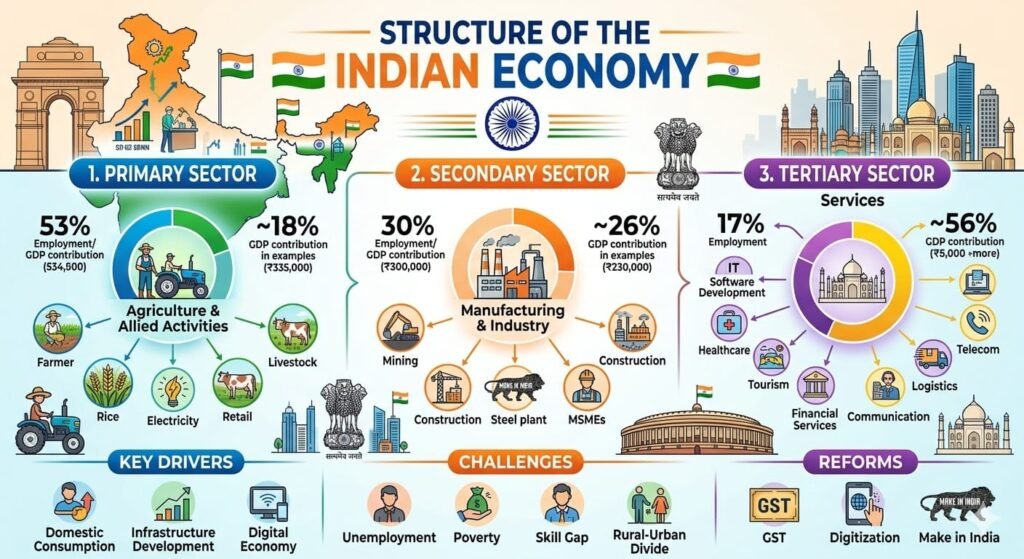
- Introduction:- What Makes India’s Economy Special????
The Indian economy is often described as a mixed economy.
This means India uses both:-
Market-driven growth (private companies, competition, entrepreneurship)
Government-supported growth (public sector, welfare policies, infrastructure building)
This balance gives India strength.
India is also home to a young and energetic population, a growing middle class, vast natural resources, and a rapidly rising digital sector. These factors have created a strong foundation for long-term economic growth.
- The Three-Sector Structure of the Economy:-
To understand how the Indian economy functions, we classify it into three major sectors: - Primary Sector – Activities based on natural resources
- Secondary Sector – Activities that involve manufacturing and construction
- Tertiary Sector – Activities that provide services
These three sectors are interconnected and support each other like three important pillars.
( explore each one in a clear and simple manner.)
- Primary Sector:-
(The Base of India’s Rural and Natural Economy)
The primary sector includes all activities that directly use natural resources.
A. Agriculture:- (The Lifeline of Rural India)
Agriculture has been India’s traditional strength.
Millions of people depend on farming for their livelihood.
India grows a wide range of crops—rice, wheat, pulses, fruits, vegetables, cotton, sugarcane, spices, and oilseeds.
Why agriculture matters???:-
Provides food security
Offers employment to a large population
Supplies raw materials to industries
Supports exports and rural income.
Even though its share in GDP has reduced due to growth in industries and services, agriculture is still a crucial pillar of the economy.
B. Animal Husbandry, Fisheries, and Dairy:-
India is one of the world’s top producers of milk, fish, and poultry.
These activities strengthen rural incomes and help farmers reduce their dependence on crops alone.
C. Forestry and Mining:-
India has forests, minerals, iron ore, coal, limestone, bauxite, and precious metals.
Mining provides essential raw materials for industries and contributes to exports as well.
In short:-
The primary sector builds the economic base.
Without it, industrial and service sectors cannot grow.
- Secondary Sector:-
(The Engine of Industrial Transformation)
The secondary sector converts natural resources into finished products.
It includes industries, factories, manufacturing units, and construction.
A. Manufacturing Industries:-
India’s manufacturing base is diverse. It includes:-
Automobiles and auto parts
Steel and cement
Chemicals and plastics
Electronics and mobile phones
Pharmaceuticals
Textiles and garments
Manufacturing is important because it:-
Creates large-scale employment.
Adds value to raw materials.
Strengthens exports.
Helps India become a global production hub.
Government schemes like Make in India and PLI (Production Linked Incentive) aim to boost industrial growth and attract investments.